The 5 Things Men 40+ Want in Life (and How to Get Them)
If you’re 40+ you know you want different things in your life than you did in your 20’s.
But maybe you can’t put your finger on exactly ‘what’ it is you want or you know what you want but don’t know ‘how’ to get it.
So to give you a head start, in this blog I’ve laid out the 5 things I’ve noticed men 40+ want in life. Of all the things I’ve noticed men 40+ want in life, these 5 are the standouts that come up time and time again. None of these things will be new to you. In fact, they will all be familiar. They will all make sense. The other interesting thing I noticed is, the 5 things aren’t random and separate. There’s an order to them. They’re linked together in sequence as part of a larger transformational process of renewal and reinvention.
In this blog, I’ve de-coded the 5 things and explained ‘why’ men want them in life and why they move through them in sequence. Then I’ve provided a comprehensive guide for ‘how’ to get them. This gets into the fundamental nuts and bolts and translates my experience and real life client stories into day-to-day practical steps and tools you can apply to your life. On top of that, I’ve thrown in YouTube videos of credible middle aged blokes you’ll be able to relate to talking about these topics. Plus a few useful books in there as well to take you on a deep dive.
My goal for this blog is to give you language, a road map and way points that will guide you to make the most of the second half of your life.
There’s a lot packed into this blog, and it ended up being a 30-minute read. If the idea of sitting down for a 30-minute read when you’re not even sure it will interest you feels like a big ask, don’t worry. Before the 30-minute version, I’ve put together a quick 3-minute read version of the 5 things give you a taste of what’s ahead and help you decide whether you’d like to dive into the full 30-minute read.
When reading this, bear in mind that every man’s life is unique. Your life might not “match” what I’ve written, and not every aspect of the 5 things may apply to you. The 5 things may apply to varying degrees—you might identify with, relate to, or resonate with some aspects and not others—and you may connect with some aspects now and others from your past. It’s like a sliding scale: you may see 100% of yourself in the 5 things, or only 20%. Some parts you may not agree with; others you might think I’ve nailed it. Another thing is, if it doesn’t match your life, other blokes might come to mind where you think, “That’s Jonno.”
Now we’ve set the scene, the best starting place, for both versions, is to think about this question: What causes a man at 40+ to want something different in life?
I notice that it’s typically some kind of “urgent life event.”
With that being said, here we go with the 3-minute version of the 5 things men 40+ want in life.
The 3-Minute Version of The 5 Things
I notice men will be going along fine in life, until some sort of unexpected urgent life event happens around the age of 40.
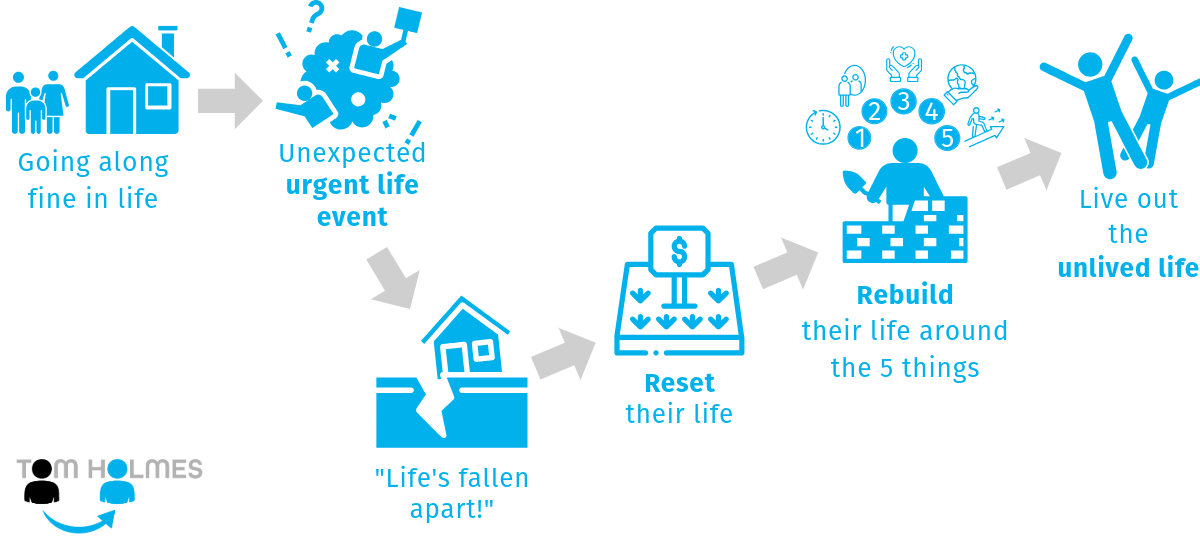
Commonly, this is the death of a friend, parent, family member or colleague; redundancy or job loss; separation or divorce; a major operation; a serious “health scare”; or a heart attack. In the aftermath of an urgent life event, it’s common for men to express thoughts like, “My time is running out” “That could happen to me” “Whats the point?” “I’ve lost everything” “The world’s turned upside down” “Life’s fallen apart” “Nothing will ever be the same” “I’m a failure” or “I don’t know who I am anymore.”
It makes them rethink or “reset” their whole life, rearrange their life priorities, and acts as the catalyst for the 5 things men 40+ now want in life, which are:
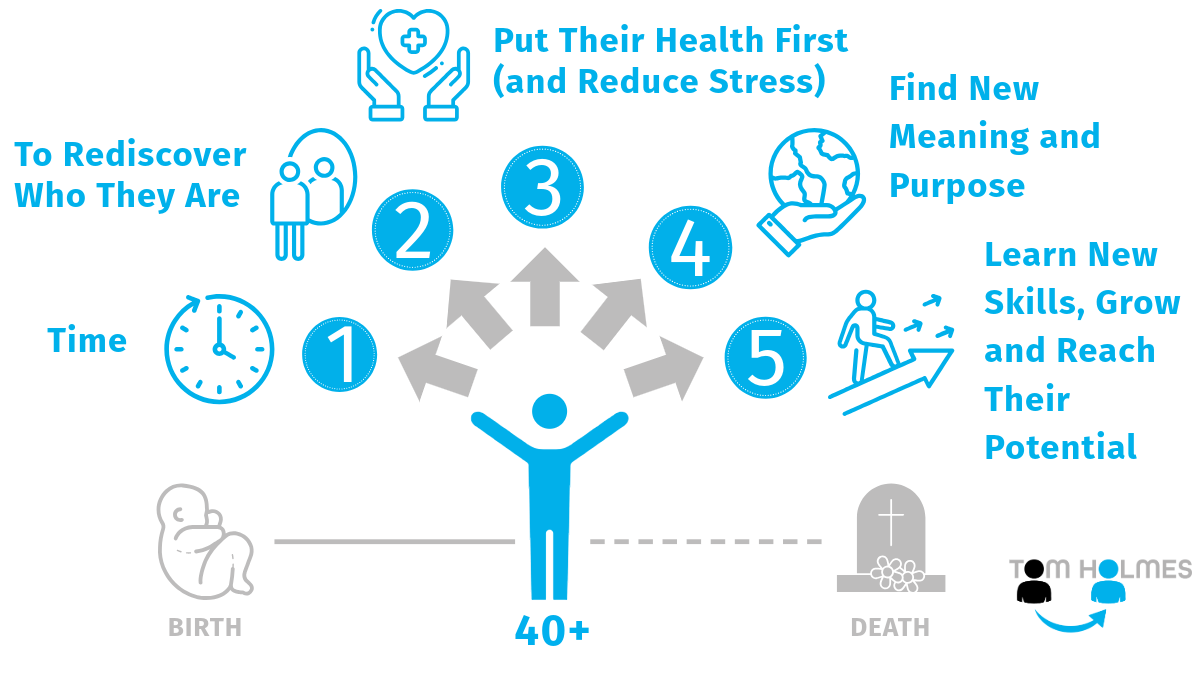
But while they want the 5 things, the thread that ties all these things together is the search for the unlived life. You see, generally, a man’s objective in the first half of a life is to provide for their family and kids. But in order to provide for others, men frequently have to put their own wants aside. The result is that they can find themselves living two lives: there is the life they live on the outside, shaped by responsibility, duty and expectation, and the unlived life within them—the dreams, desires, interests, and possibilities that are hidden beneath the surface.
But the urgent life event acts as a powerful “wake up call” and now in the second half of life, from 40+, they’re playing catch-up. They want to go back, reclaim their unlived life, live it out, and become more fully themselves. They want to break free from obligations, expectations, and self-imposed limitations, and do the things they have missed out on or postponed for years—before it’s too late. But to do the things they want, they have to give up parts of their current life structure that no longer serve them and “rebuild” their life around the 5 things. The 5 things then act like building blocks for their new 40+ life structure and enable them to live out their unlived life.
The first of the 5 things I notice men want is 1) time. Time is the key that unlocks all the other things.
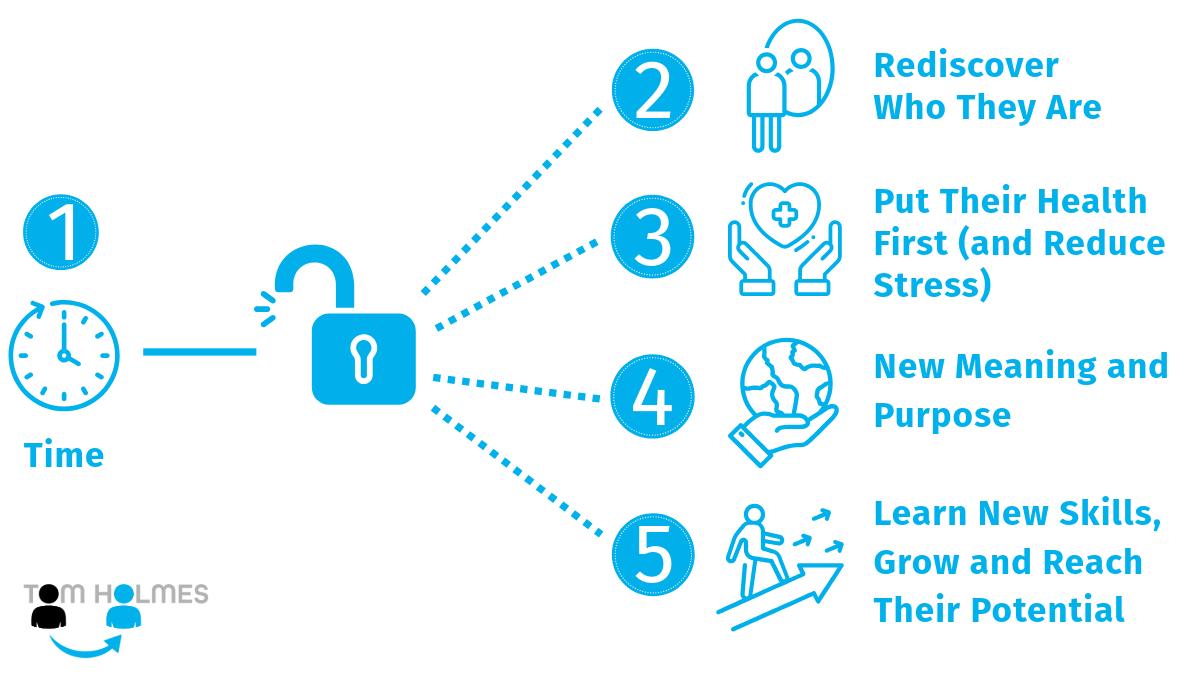
After the urgent life event, many men find themselves thinking,“Thank God there’s still time.” They become acutely aware that time is finite and want to make the best use of the time they have left. Time suddenly becomes their most precious currency. But gaining more time often requires a trade-off. The trade they need to make is to let go of or give up money in exchange for time. In effect, they use money to buy them time.
They go through an economic remodelling so they’re earning just enough to live simply, modestly and freely. This opens up the mental and physical space to “lean in” to rebuilding their life structure around the next 4 things. They get to work on rebuilding. They 2) rediscover who they are by allowing themselves to feel, recalibrating relationships to be more themselves, discovering their values, and finding a deeper connection with other men who inspire them and pull them forward into a new version of themselves. Next they build a daily routine, structure, habits and practices that keep them 3) healthy and get their stress under control.
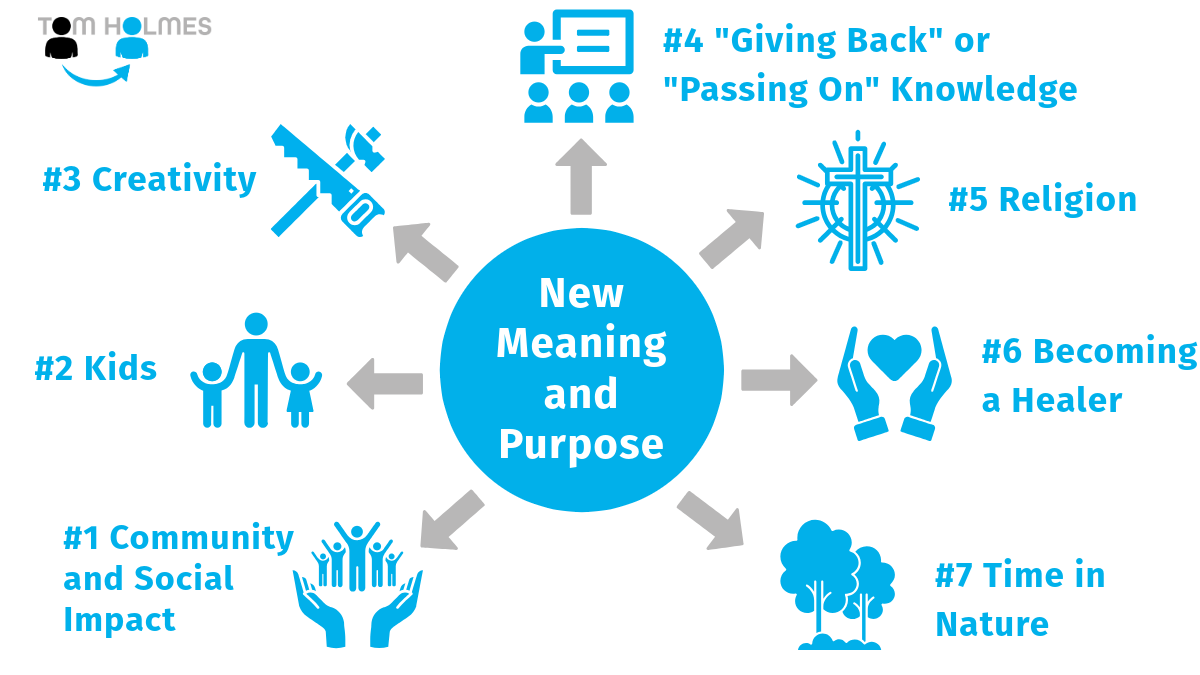
Laying these building blocks gives them a solid foundation to set out and find a 4) new meaning and purpose—one that I notice is anchored in making a distinctive, lasting mark on the world and leaving a legacy that endures, which can be realised in any one—or a combination—of ‘7’ ways: #1 by having a positive social impact on others, their community and future generations.; #2 leaving a legacy through their kids; #3 pursuing creative endeavours; #4 by “giving back” or “passing on” their knowledge through mentoring, coaching, teaching, or speaking; #5 through religious or spiritual engagement; #6 by becoming a healer; or #7 spending time in nature, travelling and adventure.
Men tend to think of these as 7 “tick boxes.” They often tick a number of these boxes. In other words, it’s rarely just one thing that provides new meaning and purpose; more often, it’s the combination of many things that provides new meaning and purpose for men over 40.
A by-product of rebuilding their life around these things is they 5) learn new skills, in what “they’re interested in.” Along the way, they build new habits, hone skills and develop tools. As a result, they can see themselves improve, develop, expand and get better. This translates into concrete signs of progress, forward movement and growth. Day-by-day they’re uncovering and living out the unlived life within them. This gives them the sense of leading a fulfilling and rewarding life and of reaching their potential.
Curious to get into the practical steps and tools for ‘how’ you can make these things happen? Read on.
The 30-Minute Version of The 5 Things
The Urgent Life Event
I notice men will be going along fine in life, until, out of the blue, some sort of urgent life event, crisis, calamity or something terrible happens around the age of 40. This can be:
Loss, endings or life transitions
The death of a friend their own age, or the loss of a parent, family member, or colleague.
Separation, divorce or the ending of a long-term relationship.
Children leaving home (“empty nest”).
Physical health challenges or “health scares”
Diagnosed with cancer, a serious or life-threatening illness or medical condition, or having a stroke or heart attack.
Physical health problems like IBS, pre-diabtetes, diabetes, migraines, pneumonia, weight gain, insomnia or joint pain.
Serious decline in physical ability, a sudden health breakdown or a significant “health scare.”
A major operation like hip/knee replacement, heart bypass or weight-loss surgery.
A serious injury or accident.
Mental health challenges
Depression, burnout or addiction (this was my urgent life event).
Diagnosed with a mental health condition or disorder like ADHD, Bipolar, Autism (Asperger’s), Generalised Anxiety Disorder, OCD or PTSD.
Work, career disruption and financial change
Being made redundant, sudden job loss or an abrupt job exit.
Selling a business.
Losing a business via voluntary closure, liquidation or bankruptcy.
Major life milestones
Turning 40, 50, 60 or other significant age.
Any one—or a combination—of these urgent life events can crack a man's life wide open, particularly when it arrives unexpectedly, leaving him feeling as though the ground beneath his feet has suddenly given way. Such experiences can profoundly alter how he thinks about life and his place within it, hitting home in a way that causes him to question assumptions they may have carried for decades. What follows can be deeply unsettling: he may be forced to confront his own death, find himself unable to function normally, see the life he has built compromised, watch his familiar world shatter around him, experience the dismantling of long-held beliefs, feel his sense of self become destabilised, see meaning and purpose stripped away, and suffer a profound loss of identity.
In the aftermath of an urgent life event, it’s common for men to express thoughts like, “My time is running out” “I’ve lived more of my life than I’ve got left to live” “That could happen to me” “I could be next” “If I don’t look after myself, I won’t live much longer” “I’ve lost everything” “I wish I could go back” “The world’s turned upside down” “My reality has been shattered” “Life’s fallen apart” “My world has come crashing down around me” “I’ve hit rock bottom” “Nothing will ever be the same” “I don’t know what’s real anymore” “Whats the point?” “I have lots of questions about what’s really important” “Is this all there is?” “Does anything I do ‘actually’ matter?” “I’m a failure” “I don’t know who I am anymore” or “I’m truly alone.”
The urgent life event(s) makes them rethink or “reset” their whole life. Some men feel like they’re “starting all over again.” Next, it makes them rearrange their life priorities and acts as the catalyst for the 5 things men 40+ now want in life.
I’m not saying it’s always an urgent life event. For 90% of men it is. But for the other 10%, it shows up as a “creeping despair”, “silent drowning”, “quiet falling apart” or “slow grinding down”. Over the years, their health, sense of meaning and purpose, and identity are steadily eroded. They can wind up in a similar place to the blokes who experience an urgent life event—feeling stuck, trapped, burnt out, tired of the same old thing, and just need a change. Ultimately, the path may be different, but the destination is the same. Both the ‘erosion guys’ and ‘urgent life event guys’ end up wanting the same five things, so for simplicity I’ll continue using the urgent life event example.
While the men want the 5 things, each of which I’ll cover next, the thread that ties all these things together is the search for the unlived life.
The Unlived Life
A man’s life can simply be divided into two half’s: the first half of life and the second half of life. Some men refer to it as the first act, and the second act. But for this blog, I’ll stick with half’s. The urgent life event typically occurs in midlife around the age of 40, at the juncture between the two half’s. The urgent life event causes the half’s to look very different.
Generally, in the first half of life, a man’s objective is to climb the ladder, secure a stable job, and build a life structure so that he can provide for his family. For many men, being the provider becomes their central responsibility. While this role can bring purpose, pride and security, it can carry hidden personal costs. To provide for others, men frequently put their own wants aside—postponing ambitions, holding themselves back, compromising personal fulfilment, and burying parts of themselves in service of the people who depend on them. What they want is neglected, deferred, sacrificed, or put on hold. These are often the constraints of being a husband, father and provider. It may not be ideal, but for many men it is an unavoidable reality. By the time they’ve earned a living, paid the mortgage, kept a roof over the family’s heads, looked after their wife and kids, and “carried the weight of the world” that comes with those responsibilities, there is often nothing left for them. Their own needs often fall to the bottom of the list—they end up putting themselves last. They become experts at looking after everyone else while neglecting their own lives. The result is that they can find themselves living two lives: there is the life they live on the outside, shaped by responsibility, duty and expectation, and the unlived life within them—the dreams, desires, interests, and possibilities that are hidden beneath the surface.
But the urgent life event acts as a powerful “awakening experience” or “wake up call” and now in the second half of life, from 40+, they want to “take back” these parts of themselves they’ve set-aside for years. Some men describe it as wanting to "get their life back" or “making up for lost time.” Other blokes feel as though they’re “playing catch-up”, driven by a need to go back, reclaim their unlived life, live it out, and become more fully themselves. They want the freedom to live more authentically, explore interests they have ignored, awaken dormant talents, and tap into unrealised potential. Many feel a strong urge to “be selfish” and put themselves first for perhaps the first time in their lives—to break free from obligations, expectations, and self-imposed limitations, and do the things they have missed out on or postponed for years. They want the opportunity to do what they have always wanted to do—before it’s too late.
But while they want this outcome, they might not know ‘how’ to make it happen. At the same time, they don’t want to risk jumping into it or making rash, impulsive decisions that could lead to losing or hurting others. Because of this, quick fixes aren’t the answer. Instead, they need to go back to the drawing board and come up with a decent long-term plan. That plan involves modifying their current life structure—deconstructing, dismantling, letting go of or giving up parts of that structure that no longer serve them—and “rebuilding,” reshaping or restructuring their life around the 5 things they now want. The 5 things then act like the building blocks for their new 40+ life structure and enable them to live out their unlived life.
Here’s a video from Peter Fritz (YouTube channel: Act Two) talking about the first act: solidifying a base and providing for family and children, and the second act: renewal, reinvention, choosing what matters and pursuing things that make you feel alive.
The first of the 5 things they want is time. Time is crucial. Time is the key that unlocks all of the other things.
1. Time
“Controlling your time is such a key to happiness. Having more control over your time is becoming one of the most valuable currencies in the world.” —The Psychology of Money
Wanting their time back
In the first half of their life, many blokes find themselves saying they “just don’t have time” or that time has always been their battle. They feel like they don’t have enough time—and in many ways, that’s exactly the case. At work, they operate on someone else’s schedule. When they get home, their time is absorbed by looking after the family and raising kids. At the weekends, they’re running around doing the kids sport and family commitments. There’s no time left for them.
But the urgent life event—a redundancy, divorce, life-threatening illness, “health scare,” heart attack, or the loss of a parent, family member or colleague—can bring this reality into sharp focus. In the aftermath, men often find themselves saying things like: “My time is running out” “I’ve lived more of my life than I’ve got left to live” or “Thank God there’s still time.” They become acutely aware that time is limited. Time suddenly becomes their most precious currency, and they become less interested in simply staying busy and more interested in making their remaining years count.
As a result, at 40+ they want their time back and to have control over how they spend their days. They ask themselves: “How do I want to spend my time?” They want the freedom and autonomy to call the shots, work on their own terms, on their own schedule, and in their own way. They no longer want to be at work at 7am every morning. Instead, they seek greater flexibility: the freedom to work part-time, combine office-based and hands-on work, or take a career break, career holiday, or extended period of time out to reassess what they want from the next stage of life.
So, how do they actually get more time?
Money buys them time
I’ve noticed blokes get more time by making a trade. They let go of or give up money (inc. income, wealth, salary and lifestyle) and identity (inc. career, status, position, power and title) in exchange for time. In this section I’ll cover money; Identity is covered in the next section. This is not just a physical letting go of money, but a psychological one.
In the first half of life, many men become consumed by the pursuit of money. Beneath this pursuit are often powerful fears and beliefs: the fear of not having enough money, being poor, or going broke; the belief that money is proof of competence & success; the belief that money provides security; or the belief that money is a measure of their worth. The problem is that these fears and beliefs create an endless game that can never truly be won. No matter how much money they accumulate, it never feels like enough. What begins as a search for security gradually takes on a life of its own, resulting in many men spending decades chasing money without ever feeling secure.
So, at 40+ they examine what money psychologically represents in their life—what are the benefits and upsides of chasing money and what are the downsides or drawbacks. They ask themselves: What has chasing money given me? What has it taken away? By becoming aware of the fears and beliefs that have driven their pursuit, they can begin to challenge and “reset” them. In doing so, they stop seeing money as the end goal and start seeing it as a tool. Rather than using their time to acquire more money, they realise they can use money to buy them time. This represents a profound psychological shift: the first half of life was characterised by money → security → success, whereas the second half becomes money → freedom → time.
Now we’ve set the scene on the psychology of money, we can get into the practicalities of how they actually get that money.
Economic remodelling
To get the money—that they use to buy them time—they go through an economic remodelling. Here’s the tools and strategies for how they do it:
Increasing money
They sell off stuff. They write down what they need, their essentials, and then what they don’t need—what are the nice to haves, but they could live without. Then they sell off anything they don’t essentially need—typically things like collections, memorabilia, cars, boats, camper vans, motorbikes. Some men even sell their businesses, investment properties, stocks or shares. By selling this stuff, they create a “pot of gold”, “emergency fund” or “safety net”—typically somewhere between $100,000 and $500,000—that they give themselves “permission” to use to buy them time. Some blokes think of this as having at least 12 months’ worth of living expenses sitting in the bank. For some men, however, this money does far more than buy them time. It becomes the foundation for the second half of their life. The wealth accumulated through years of hard work, successful investments and financial wins in the first half of life generates the passive income needed to support them through the second half. In effect, the success of the first half creates the freedom to live differently in the second.
Decreasing money
They reduce their expenses to the bare minimum and eliminate debt wherever possible. This involves a conscious shift in priorities: spending on their life rather than their lifestyle. Instead of continually increasing their standard of living, they live below their means, keep lifestyle expectations in check, and focus on buying back time. The added benefit is that lower expenses often lead to lower financial stress.
Work out their Minimum Viable Income (MVI)
They open a spreadsheet and calculate the minimum living costs they need to live simply. Basically, what they need to exist. They list every expense—bills, mortgage repayments, household costs, family commitments and other outgoings. They get these living costs to a rock bottom dollar monthly figure. This figure will then tell them their MVI (Minimum Viable Income): the minimum amount they need to earn each month to cover their living costs. They refine the numbers until they can confidently say, “I need to earn at least $4,000 per month.” This exercise is often eye-opening. More often than not, they discover they need far less money than they originally thought. On the surface, this looks like a financial exercise. In reality, it is an exercise in freedom. Every dollar they remove from their required income gives them more choice over how they spend their time and who they become. This reinforces a central theme of this blog: the second half of life is less about accumulating and more about liberating.
Role reversal
Many men navigate this transition with the support and encouragement of their wife or partner. In some cases, they take turns being the primary breadwinner, with their partner stepping into the lead income-earning role. While this arrangement can create greater freedom and flexibility, it often requires men to confront a difficult psychological shift: learning to receive financial support after years of defining themselves as the provider.
Other options
Not every man creates more time and freedom by building a large financial buffer or reversing roles. Some dramatically reduce their living costs by moving in with parents, staying in a family-owned property, living with siblings, or temporarily staying with friends, allowing them to live rent or mortgage-free. Some are also able to use a redundancy payout, inheritance or other windfall to fund a period of transition.
While the circumstances differ, the objective is the same: creating the financial breathing room needed to step off the treadmill, buy back time, and redesign the second half of their life.
Here’s a video from Wayne Phipps (YouTube channel: Over 50’s Reset) talking about selling off stuff, creating a MVI and why time became so important to him.
“Being busy” vs “slowing down”
The problem
But there’s a big problem. Even if men get their time back, they often don’t know what to do with it other than work. It’s common for men to tell me they “haven’t stopped their whole lives.” Many have spent years in a constant state of “being busy” at work—being productive, staying on top of endless demands, juggling responsibilities, doing things, making progress, pushing themselves, working hard, and getting things done. Over time, being busy has become their default mode—so ingrained that some describe it as simply their nature. For many men, “being busy” has come to define the structure, routine, and rhythm of their entire lives. In fact, it’s become more than a habit; its become part of their identity.
As a result, having any sort of free time or downtime—with no expectations, responsibilities, or demands—can feel surprisingly uncomfortable. They become anxious, restless, or even panicked by “the unstructured day,” “not being productive,” “having nothing to do,” or “not achieving anything.” So they instinctively return to what they know best and fill the space with more work. In other words, if they have some time, they’ll fill it with work. The irony is that at the root of many of the problems in their life that they’re trying to escape—stress, burnout, health issues, relationship tension, an unhappy wife, or even divorce—is the very habit of always “being busy” at work. The solution? They need time to unlearn and “reverse” the being busy mindset and do arguably the most important task a man can do in his life—learn to “slow down.”
I notice men slow downin 3 ways:
Disconnecting
First, they develop new habits around disconnecting from social media, doomscrolling, news, and screens in general. They may switch off their phone, put it on aeroplane mode, or leave it behind altogether.
Slowing down activities
Second, they discover these healthy “slowing down” activities:
Sitting in the garden, having a cuppa
Spending time in nature
Creativity/hobbies: Woodwork, motor mechanics, painting, playing an instrument
Cooking
Reading a book
Reflecting and journalling
Going for long drives
Sitting in the park
Going for a walk
Taking an afternoon nap
Gardening and getting their hands in the dirt
Yoga, massage, ice baths, breathwork
Think of this as building a toolbox of healthy ways to regulate. When they’re anxious, agitated or irritated, they can open the toolbox, reach in and grab the tool they need.
New daily structure
Third, they build these “slowing down activities” into a new daily structure, routine, and rhythm. I notice that men find daily structure crucial. Without daily structure, men describe feeling “unmoored” “like they have sea legs” or “they have no foundation.” Daily structure keeps men stable—solid, supported, physically standing, and oriented throughout their day.
The old daily structure was built around being busy at work. But when work is no longer the organising framework, it helps to replace it with something intentional rather than leaving a wide expanse of empty space. To fill that space, men need a new structure built around “slowing down” activities. Rather than organising the day around meetings, emails, deadlines, and work demands, they organise it around activities that help them slow down and reconnect with themselves. Practically, this means breaking the day down, and rebuilding their day around these “slowing down activities.” A new daily routine might include a morning walk in nature, reading at a café, spending time gardening, or cooking in the afternoon. While these activities may seem simple, they still provide a sense of achieving things and getting stuff done. Men continue to feel productive, but in a way that supports their wellbeing rather than drains it.
One client called learning to slow down, “retirement training.” I agree. It’s inevitable that at some point a man will have to stop and slow down.
Slowing down
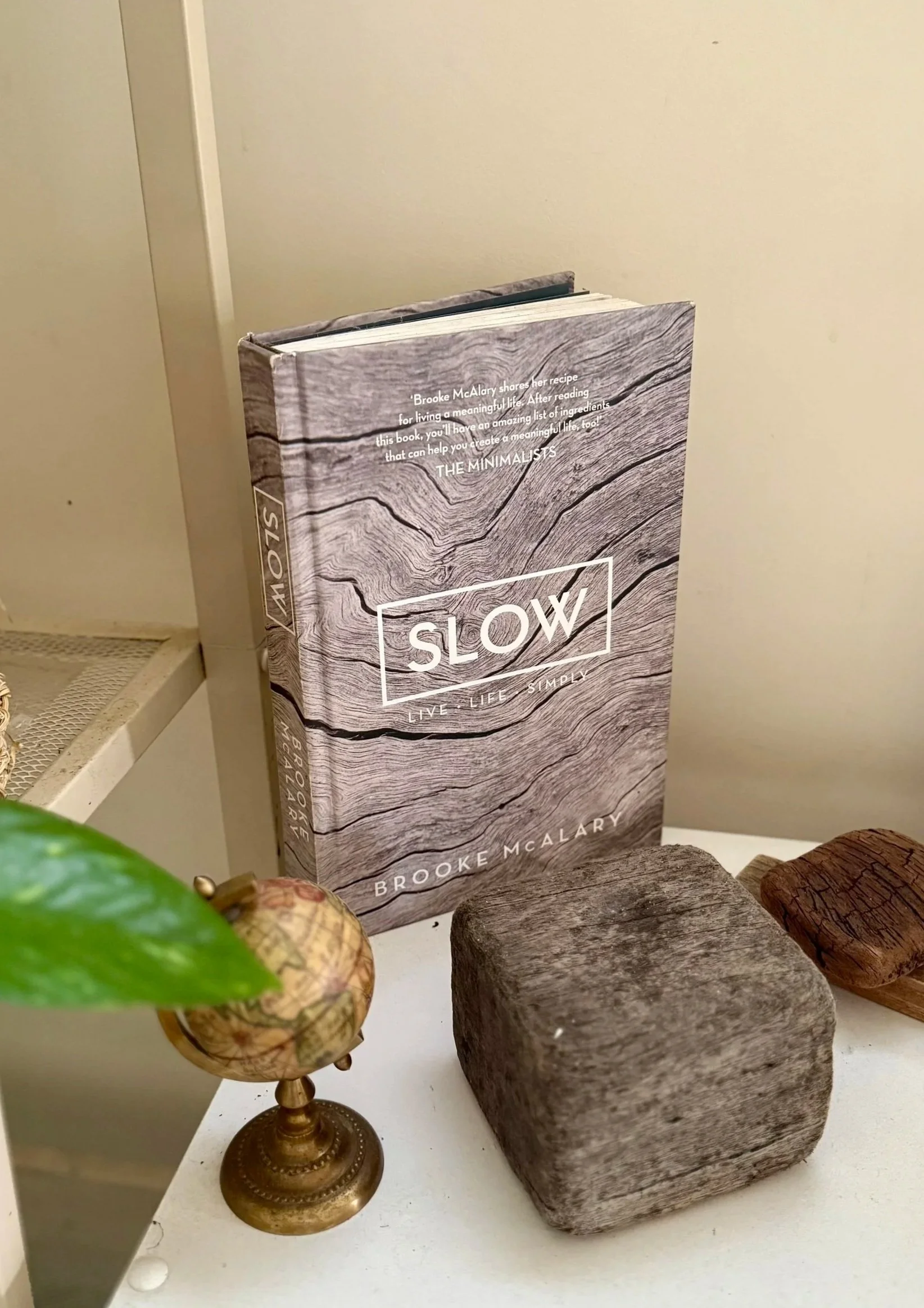
Slowing down unfortunately doesn’t happen overnight. It takes deliberate practice. After my urgent life event, I found myself during a 2-week decompression time out in a bookshop in Byron Bay picking up this book, Slow: Live Life Simply.
I didn’t seek out “slowness.” But when I saw the title, I intuitively knew I’d needed “slow” for a long time. Here’s a picture of it still standing on top of my bookshelf behind my desk as a day-to-day reminder for me to practice “slow living.”
Creating space
Slowing down creates the physical and mental space needed to rebuild. Men often describe it as finally having the “brain space” or “mental bandwidth” to “lean in” to the rebuilding process. With that space restored, they can begin rebuilding their life structure around the 4 other things: 2) rediscovering who they are; 3) putting their health first (and reducing stress); 4) finding a new meaning and purpose; and 5) learning new skills, growing and reaching their potential.
While this may sound straightforward, meaningful change in these areas takes time. It requires space to shift mindset, explore possibilities, experiment with new ideas, and reflect on what feels right. It means planting seeds, discovering new interests, expanding networks, trying different paths, testing opportunities, building practical tools, and developing habits that support a new way of living—all of which require the space and time to take root and grow.
Books on time and money
Here are a few books you might find useful:
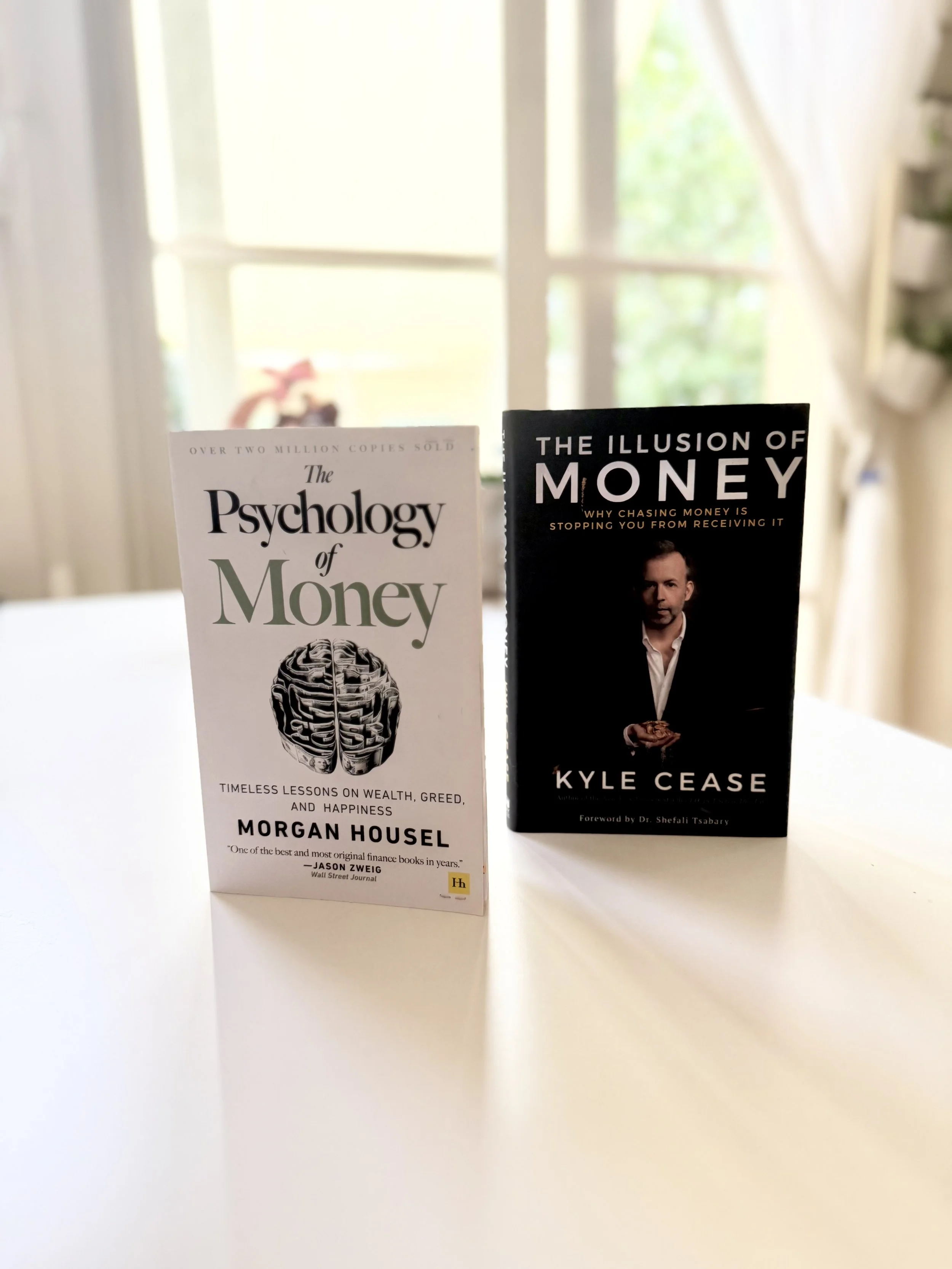
The Psychology of Money: Timeless Lessons on Wealth, Greed and Happiness, provides a straight-shooter look at the psychology behind how we view money.
The Illusion of Money: Why Chasing Money is Stopping You From Receiving It, lays out how our fixation with money costs us our freedom, and our ability to step into our true power.
Now they’ve got time, they can begin to 2) rediscover who they are and 3) get their health and stress under control.
2. Rediscover Who They Are
In the first half of life, many men build their identity primarily around being providers, with their roles as fathers, sons, and husbands flowing from that responsibility. Their sense of self—who they are, how they see themselves, and their place in the world—is shaped by their ability to provide. For many men, career progression becomes central to this identity because it is seen as the most direct and socially prescribed path to fulfilling the provider role. As they climb the ladder and accumulate status, money, position, power, authority, titles, and recognition, they gain a growing sense of security and certainty that they can provide for and protect those they care about. But what begins as a way of fulfilling the provider role gradually evolves into a source of identity in its own right. As a result, their identity as a good provider becomes increasingly tied to achievement, advancement, and career success—climbing the ladder, proving themselves, getting ahead, becoming somebody, and making it.
When the foundations upon which their provider identity has been built are disrupted, the consequences can be profound. An urgent life event—a redundancy, divorce, life-threatening illness, health scare, heart attack, or the loss of a parent, family member, or colleague—can cause that identity to crack. For some men, these events strip away the very things that have given them a sense of who they are, leaving them feeling as though they have lost their identity entirely. In the aftermath, men can find themselves questioning their most basic understanding of who they are, saying things like: “If I am no longer who I was, then who am I?” “Without work, who am I?” “What if I now don’t have anyone to provide for?” or “I don’t know who I am anymore?”
They want to return to how things were before the urgent life event. But the event has changed them—and their world—so profoundly that they cannot go back. In many cases, the place they long to return to no longer exists. The marriage has ended. The house has been sold. The business has failed. The career, role, or job is gone. There is simply nowhere to go back to. They long to return, only to discover that returning is impossible. The old identity is lost and cannot be recovered. As a result, they can find themselves feeling like a stranger to themselves, adrift in an unfamiliar world—as though they are alone in a small boat on the open ocean, with no land in sight.
This is a bitter pill to swallow. For many men, particularly high-profile professionals such as lawyers, executives, business owners, and professional athletes, their identity has become deeply tied to their sense of self-worth. Over time, they may have come to measure their value as a man through their career, status, achievements, or position. For decades, these markers have shaped how they see themselves and their worth in the world, often setting up an unhealthy dependence on that identity. The result is that their identity becomes fused with their work. It is no longer simply a job—their job defines who they are. When that identity is stripped away, they can feel worthless, powerless, invisible, or as though they no longer matter—as if they’re nothing or nobody. As a result, detaching or letting go can be extraordinarily difficult; they cling to the identity with everything they have, even as it begins to unravel. They find themselves caught in an in-between space—torn between the familiarity of the past and the uncertainty of what lies ahead. In his video The Quiet War inside Every Man Over 40, Peter Fritz captures this experience well: “A quiet battle begins. A battle between who you were and who you still wish to become.”
But what if the identity that has been lost was never who they truly were? They are more than the identity they’ve built around being providers and career progression. In fact, a gap has most likely grown between the “external” identity they’ve been presenting on the outside in the first half of life and who they authentically are underneath. In many ways, throughout the first half of life, they have worn a “facade” “mask” or “suit of armour” that has concealed who they really are. But the urgent life event strips away that protection, leaving them confronted with a fundamental question: Who is the man left standing underneath? It’s no wonder many men feel confused, lost and directionless at this stage of life.
Yet beneath the disorientation lies an invitation—to let go of who they were, “shed the old skin” and “turn inward.” In doing so, they can find the pathway back to themselves and rediscover who they are. From that foundation, they can begin the work of consciously building who they wish to become in the second half of life. In other words, rediscovering who they are provides a new sense of direction, purpose and meaning. The path forward is found by going inward. They have to go in, in order to come out. In fact, “the way in, is the way out.”
In my experience, men tend to “turn inward” and rediscover themselves in 5 key ways:
#1 - Allowing themselves to feel
In the first half of life, men don’t really allow themselves to feel. They’ve got too many other priorities: work, raising kids, earning money. And too many things to be: decision maker, fixer and stoic. Feeling slips to the bottom of the list. But the feelings are still there. They build up over the years.
Now at 40+, the feeling tank is full—and there’s no more room. What Joseph Jaworski describes in his book Synchronicity: The Inner Path of Leadership, is a common story for many men. After his separation, and later, his divorce at the age of 41, Joseph says, “Not only was I losing my wife and son, but the picture of my whole life had been shattered. I found myself spontaneously letting out my pain through deep, gut-wrenching crying. Maybe I was crying about the loss of my family—but I was also crying about the unreflective life I had led. And maybe I was releasing the pent-up pain I had had over a number of years. But maybe it was just that for the first time, I was really allowing myself to feel.” In that moment, Joseph’s feeling tank burst. But it begs the question: Does it need to take a divorce for men to allow themselves to feel for the first time?
I hope not. At 40+ men urgently need to allow themselves to feel. They need to drain the tank before it bursts. But how?
Here’s what I’ve noticed about how blokes allow themselves to feel:
They use a conduit, bridge or portal to their feeling world. They use ways that don’t involve “talking” about how they feel but where they “experience” how they feel. Many men struggle to put language to how they feel—they can sense something happening internally but often can’t describe it. These ways bypass the need for “talking.” Instead, they can drop into a container or experience that “tells them” what’s happening for them. They may start with a one off class, workshop or experience that develops into a daily or weekly “practice.” Having this practice gives them an “outlet”—a space to check in with how they are functioning, to free up mental bandwidth, and to act as a “pressure-release valve.”
Now we’ve laid the groundwork for how blokes allow themselves to feel, we can get stuck into the practical ways you can do it.
Here’s how you do it:
Join a breathwork workshop: Like Wim Hof method, Steve Beattie or The Breath Haus. One client told me that at the end of his first breathwork workshop, he was lying down in a deeply reflective state. The instructor asked the group to think about what was truly important in their lives. In that moment, he realised that one of the most important things to him was being a good father to his son.
Go to a yoga retreat or class: My girlfriend did a yoga retreat in Jan 2017. By 2018, she got me into it. It was excruciating at first but I’ve been doing yoga ever since. My story is similar to Craig White’s below.
Book a deep tissue massage: Men store emotion in the body—a massage is a great way to release it.
Go for an ice bath: Many blokes find ice baths useful for changing state and resetting the nervous system.
Brazilian Jiu-jitsu: Blokes describe BJJ as “active meditation.” The intense present moment focus clears the mind of daily stress and the range of motion unlocks stuck tension in the body.
Book in for a meditation class or a meditation retreat: I did a 10-day Vipassana silent meditation that was life changing.
Surfing: Many blokes say the time out the back of the breakers is the silent, calm, still, meditative place where, disconnected from the busyness of life, they can “have a circuit breaker” or “reset.”
Hill running: One client loves hill running. He’s said that being out in nature, combined with the “runners high” from pushing up a tough hill and the focus required to navigate the terrain helps him fully disconnect from work and life stresses.
Writing: I’ve found getting what’s in my head out on to the screen or on paper allows me to actually ‘see’ what I feel. In other words, what I feel is reflected back at me. At times, I’ve sat at the computer, tears streaming down my face, saying to myself, “yes, yes, yes. That’s it.”
It may be a bit different but what have you got to lose in trying it out?
Here’s an interview with Craig White, a high-performance international rugby coach turned life coach. At 38:24 mins you can hear him talking about a life-changing yoga retreat, “never stopping” all his life, hitting rock bottom and learning how to feel again.
#2 - Recalibrate relationships
In the first half of life, in my experience, men tend to play roles, follow scripts, live out inherited stories or repeat the same patterns of relating and responding in relationships today that they learnt in their family growing up. They don’t see this, of course—it happens unconsciously, automatically, on autopilot. So, how do I know this? Because I notice they start to see the roles, scripts, stories and patterns playing out ‘after’ the urgent life event. It’s as if the urgent life event pulls them out of their everyday existence and drops them into a new vantage point—one where they’re looking at their life from the outside in. From there, they see what was previously inaccessible to them. What could not be seen while they were in it becomes clear in hindsight. The invisible becomes visible; what was hidden reveals itself; and the bigger picture begins to emerge. They start to see how they may:
In general relationships: Always put others first, avoid conflict, are self-reliant and manage everything on their own, feel responsible for other people’s happiness, try to keep people happy, are people-pleasers, are the “nice guy,” are taken advantage of by others, experience one-sided relationships, feel that nothing they do is good enough, rush in to fix other people’s problems, keep the peace and don’t speak up for themselves, feel shame about being angry, avoid asking for help, say yes when they want to say no, tolerate unacceptable behaviour, take on other people’s problems, and feel guilty if they don’t look after others or if they “burden others” with their problems.
In their family and intimate relationships: Play the same role in their family or intimate relationships today that they may have learnt to play as a kid—the caretaker, rock, fixer, planner, organiser, rescuer, responsible one, peacekeeper, translator, go-between or mediator.
In their family: Have different responsibilities, pressure and expectations than their siblings based on birth order—eldest, youngest or middle. See how they’re part of intergenerational patterns, roles, inherited stories and scripts passed down the line from their parents and how they may be passing those onto their kids.
In their work: Have a fear of failure, or a fear of being seen as incompetent or inadequate, which has driven over-compensation mechanisms like perfectionism, over-achieving, over-investing, over-delivering, and high performance, often leading to burnout. The stress they experience at work has not necessarily come from others setting the bar high, but from the standards, demands and expectations they’ve place on themselves. They’ve set their ‘own’ bar high. Over time, they’ll begin to notice a repeated pattern of over-delivery leading to burnout cycling through their life. For a long time, they’ve believed the problem was the jobs they were in. But eventually, the penny drops. It slowly dawns on them that they, too, have been playing a part in creating this pattern.
They see how their blind spots, habit loops, defaults, tendencies, and self-deceptive manoeuvres are getting in their own way. Over the years they’ve “lost themselves,” avoided being themselves or given themselves away by falling into the same automatic patterns of interaction. In other words, the patterns have kept them from being themselves. One bloke described it as though he had spent the first half of his life on autopilot, only now taking hold of the controls. Another described it as feeling as though he had been living under a spell for the first half of his life, only now waking up and seeing things clearly for the first time. As they begin to see more clearly, men often recognise how these automatic patterns have fuelled conflict, disagreement, tension, arguments, anger, stress, and burnout throughout their lives.
Now at 40+ they don’t want to be that person anymore. They don’t want to play the same role and do the same dance. They recognise how they’ve dialled themselves down in relationships in ways that cause them to lose themselves. Their goal now is to turn those dials back up and become more fully themselves.
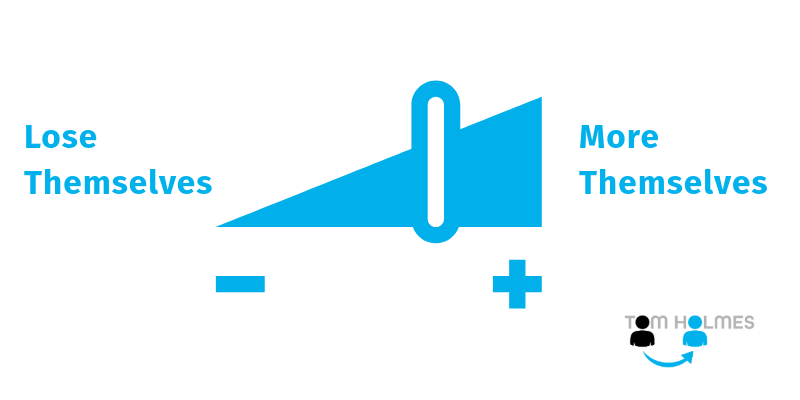
Here’s how you recalibrate relationships to be more yourself:
Step 1 - Observe old patterns:
Spot unhelpful relationship patterns. In real time, identify the patterns in your relationships that no longer serve you. Notice when you feel triggered, activated, or reactive; when a button has been pushed; or when someone has crossed a line or breached your boundaries or values. Then immediately after, unpack the details of those real interactions by journalling, making notes, drawing sketches or doing voice notes to yourself. The goal is you want to see or visualise the pattern—to have a map. They did this…I responded…they said that….they walked out…I went after them.
Step 2 - Evaluate your behaviour:
Stand back, review, and ask yourself: Is this pattern familiar? Is this a familiar dynamic? What’s works and what doesn’t? Is it having the effect I want? Is it getting positive results? Have I been here before? How did this pattern come to be? What did I want to say but couldn’t at the time? Is this who I really want to be? What ‘part’ do I play in sustaining this pattern?
By seeing the hidden relationship patterns of how you lose yourself gives you the blue print of what you need to do to be more yourself.
Step 3 - Create new patterns:
To break old patterns, requires creating new ones. That begins by interrupting the autopilot—the automatic ways of thinking, relating, and responding that have become habitual over decades. Rather than reacting in the same familiar way, you consciously choose a different response. In other words, when the old relational pattern appears, don't do what you would normally do. In his book Useful Not True, Derek Sivers says, “To expand your repertoire. To change, reach past what comes naturally. Use a different tool.”
When you feel yourself slipping into a habitual response, catch yourself and pause. Rather than running on autopilot, look for opportunities to practice, experiment, trial or “test out” different ways of relating and responding—where you are more yourself. The trick is to do the opposite of your defaults. More often than not, this means setting boundaries, being more yourself and getting needs met.
Set firm, clear boundaries: A boundary is saying I’m this, not that. You create boundaries with the word “no.” Practice being assertive, speaking up for yourself and saying “no” “no, that’s not okay” “I think about that differently” or “I’m not okay with that.” Ask yourself: What do I need to say no to? What do I need to stop doing? Every time you say no, you get clearer on who you are.
Be more yourself: Talk about yourself. Share beliefs, interests and challenges, even if it upsets others, they disapprove or sound uninterested.
Get needs met: Humans have inherent needs that drive all human behaviour. There are basic survival needs like safety, security, protection, food, shelter and water. Then above that, there are life needs like freedom, control, respect, autonomy, connection, support, fairness and belonging. All feelings are driven by needs met or unmet. Here are some examples: I’m angry (feeling) because I don’t feel listened to (need). I’m pissed off (feeling) because I feel disrespected (need). I’m content (feeling) because I feel valued (need). Ask yourself: What am I doing to meet my needs in this relationship? Practice finding your voice and requesting what you need. I notice men find it hard asking for help, respect, support and care. Practice asking for those.
It may feel unnatural and unfamiliar at first but one mini-step leads to another and soon you will be laying down new healthier patterns and recalibrating relationships to be more yourself.
Having a “look under the hood”
About this time in rediscovering who they are, many blokes have a good 3-6 month “look under the hood” with a psychologist. Psychology is really just studying patterns of human behaviour. So, amongst other personal things, the psychologist spots unhealthy or unhelpful relationship patterns that aren’t serving them—across work, family and relationships—and assists them to process old memories, thoughts, beliefs and unconscious behaviours lying at their root in an effort to adapt their relationship responses as an adult to be healthier.
But this does rely heavily on the psychologist spotting the patterns in only a handful of 50-minute appointments. While they might be good, spotting the patterns yourself can speed up the process, give you more value for money and get you quicker results. You can take the results from your real time observations back to the psychologist giving them more data to work with. Use them like an interpreter, “I’m seeing this, what’s going on?” Fact check, “are you seeing what I’m seeing?” By following this method, the psychologist can then give you clearer direction on strategies and language you can use to create boundaries or get your needs met.
But keep in mind, while it’s great to do the processing on the therapists couch, the real change and growth happens when you ‘walk out of the therapists office’ and learn to fully represent who you are in important relationships ‘outside’ of the therapy room.
#3 - Find friends and a deeper connection with other men
In the first half of life, men tend to have colleagues and friends through work. They “talk shop” and yarn about the footy and current affairs. But it often stays at the surface.
Now, at 40+, they can find themselves alone, isolated, or lonely, wanting a deeper or more “real” connection with other men outside of work They want to talk about the “real life shit”—the urgent life events they’re going through—the losses, the deaths, the physical health problems, the redundancy, the parenting challenges, the mental health struggles, the divorce, the custody battle, the pain. They feel the need to be heard, understood, seen and “got” by other men.
Here’s what I’ve noticed about how blokes find friends and a deeper connection with other men:
It’s about catch-ups and community.
First, they organise regular catch-ups with other men, built on a supportive framework: First, they make the catch-up’s a priority, put in effort and take an active role in initiating the catch-up; second, they establish a purpose, intention or topic for the catch-up; third, they have a format for the catch-up—a regular meeting location and time frame; and finally, they formally structure the catch-up’s ahead of time, create an appointment, set a date and lock them in the calendar for the week/month/year.
Second, they find a community, peer group or “brotherhood” of men with shared experiences—other men who have already walked the path they’re now walking. Men who have “been there and done it.” In his blog about Midlife Career Change, Modern Elder Academy (MEA) Founder, Chip Conley explains that navigating midlife is not a solo journey. Chip says, “You need peer groups going through similar changes. People who get it. Mentors who've navigated midlife changes in their 40s, 50s, 60s and can tell you what the road actually looks like.” Chip explains that “the right community normalises the messiness. They tell you the truth when you need to hear it.”
This is why community is so important. These men become mentors, role models, guides, and companions for the journey. They inspire new possibilities, embody values and ways of being worth adopting, and provide real-life examples of what life can look like on the other side of change. They help men find new meaning and purpose, pass back the map for navigating unfamiliar territory, and provide the support and structure needed along the way. They also offer a different perspective—seeing strengths, abilities, and positive qualities that men often overlook in themselves—and, in doing so, help pull them forward into a new version of themselves.
Now that we’ve discussed organising catch-ups and finding a community, we can explore different ways to locate a community of men, find your people, and build friendships. We’ll also look at how to apply the catch-up framework and deepen your connections with other men.
Here’s how you do it:
Deepen friendships: Identify the “surface” friends that you feel could open up with at a deeper level and say, “Hey, can we catch-up for a coffee? There’s something I need your help with.”
Find new friends: Think of someone at work whose company you enjoy and with whom you have something in common. Reach out and take the friendship beyond the workplace. Often, all it takes is a simple invitation: “Hey, why don’t we grab a coffee sometime?”
Recontacting old friends: Blokes you’ve lost contact with. Text, email, phone call. “Hey, it’s been a long time…”
Arrange boys trips: Like surfing, camping, fishing, golfing, whatever it might be. Put it in the calendar every year—like every September we go to Darwin.
Create a social group: Like social tennis, social lunches or 5-a-side-footy. Give the social group a name. Create rosters. Invite other men along to the group.
Join a men’s group/circle: Like The Men Spirit. For many men, the immediate reaction to the idea of a men’s group is, “I’m not fucking going to a men’s group.” I get it—I used to think exactly the same thing. But over time, my perspective has completely changed. I’ve been going to these men’s groups now on and off for the past 7 years. I’ve found they provide something that’s often missing from men’s lives: rules, guard rails and structure for men to feel safe to open up. Men just don’t have that structure and safety in everyday conversations. I’ve developed great friendships with blokes from men’s groups and, in many cases, connected with these blokes on a much deeper level than with my regular mates. Another unexpected benefit is the anonymity. These men aren’t part of your existing social circle. They don’t know your history, your reputation, or who you're supposed to be. There’s a freedom in that. You get the opportunity to show up fully as yourself. So what have you got to lose?
Here’s a video from Peter Fritz (YouTube channel: Act Two) talking about why men over 50 feel lonely (and how to fix it).
#4 - Discovering their values
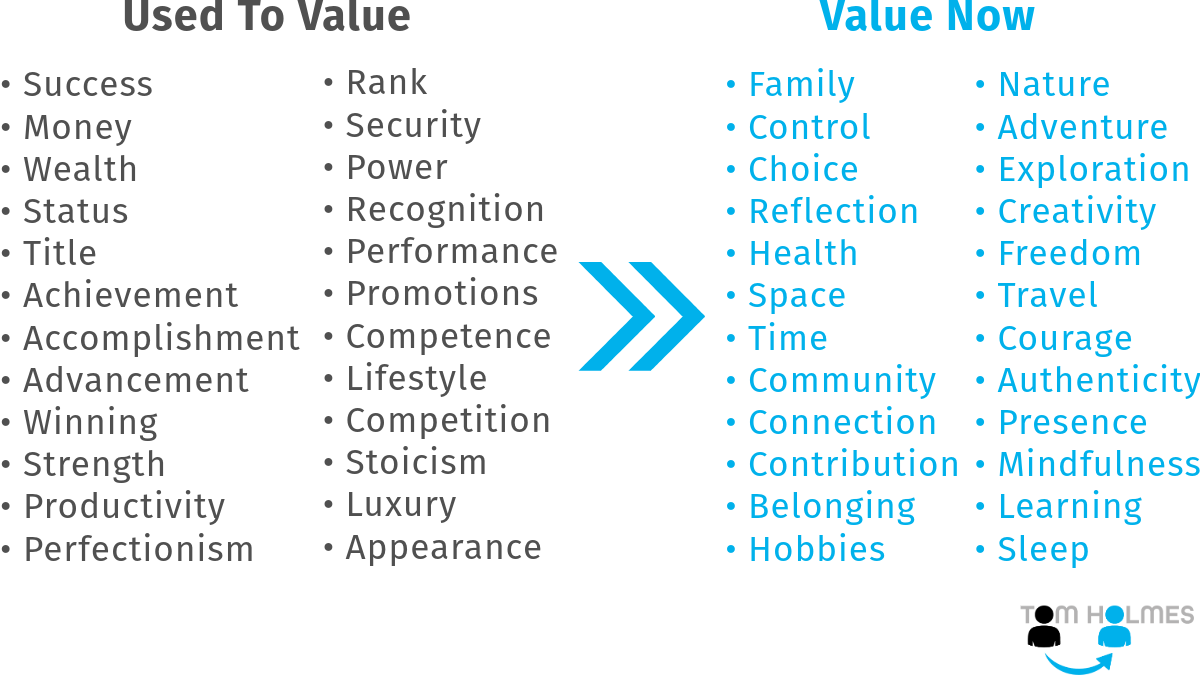
Somewhere along this journey, men begin to discover what they value. Values tell them what is important to them, what matters most, and what they genuinely care about. Up until this point, many have never stopped to consider what they value. But after the urgent life event, and through the process of rediscovering who they are, their values become clearer. Not only do they begin to notice, name, and verbalise what they value now, but they also become aware of what they used to value—the values they’ve moved away from, the values that mattered to them in the past, the values that no longer align with who they are becoming.
Over the years, through countless conversations with men about what they value now compared to what they used to value, I’ve noticed the same values appearing again and again. So consistently, in fact, that I’ve put them into a list below. It reveals a clear shift from what they used to value to what they value now. This is a bigger picture shift from what they valued in the first half of life to what they now value in the second half.
This shift is both a marker of growth and a guide for future growth. What they value now serves as both a mirror and a compass—reflecting who they have become while pointing to where they go next. In other words, the direction of their lives is controlled by what they value. Once men become clear about what they value—what truly matters to them—they begin making decisions and choices that move them closer to what they value and further away from what no longer serves them. This often involves reevaluating relationships, deepening connections with people who share similar values, and letting go of environments that no longer fit. Over time, men intentionally build a life—and cultivate a community—that reflects and reinforces what they value most.
#5 - Reflection
The final piece of men rediscovering who they are, is they need time and space for solitude and reflection. Reflection is the fertile ground between taking on board new information and making new decisions. I’ve noticed there are several key areas that men tend to reflect on:
Processing time: Men need “me time”—time and space to think things over and process what they are experiencing. This includes reflecting on what has surfaced as they allow themselves to feel, navigating the recalibration of relationships, integrating the lessons learned through deeper connections with other men, and clarifying their values.
Coming to terms with the reality of their life: They need space to come to terms with the gap between who they imagined they would be at this stage of life and who they have actually become. It is often here that their hopes, dreams, and expectations collide with the reality of their lives.
Re-evaluating success and wealth: Many men find themselves confronted with the limitations of success and wealth, and the costs involved in pursuing them. They come to realise that success and wealth have not delivered the lasting fulfilment they expected, and that attaining them often came at the expense of their health, relationships, wellbeing, passions, and sense of self. As they reflect on these trade-offs, many begin to question whether the success and wealth they pursued were worth the price they paid and whether the life they built truly reflects what matters most to them.
Grieving the loss of their old self: They grieve the loss of their old self—the identity they spent decades building through their roles, titles, achievements, and status. They mourn the passing of their "prime," the opportunities missed, the potential left unrealised, and the decisions they wish they could go back and change. They also grieve the life they had longed to live as they confront the painful possibility that some of their dreams, hopes, and aspirations may never be realised.
Noticing themselves change: Reflection is where they begin to notice the changes taking place within themselves. It offers an opportunity to recognise the subtle unfolding of new beginnings and to observe, with honesty and objectivity, whether they are allowing or resisting the process of change. As this awareness deepens, they become less inclined to push against change and more willing to give themselves permission to let the process unfold, surrendering to the journey ahead.
Contact inner compass: Through reflection, they begin to uncover their inner guidance system—their intuition—and reconnect with and start “listening to their gut.” This inner compass or GPS becomes a reference point, helping them recognise whether they are on “the right track” and guiding them toward the direction they need to take.
Who they want to be: They reflect on who they want to be as a man, husband, and father, and how they can become the best version of themselves.
Books on Rediscovering Who You Are
For a deep dive into rediscovering who you are, here are a few books you might find useful:
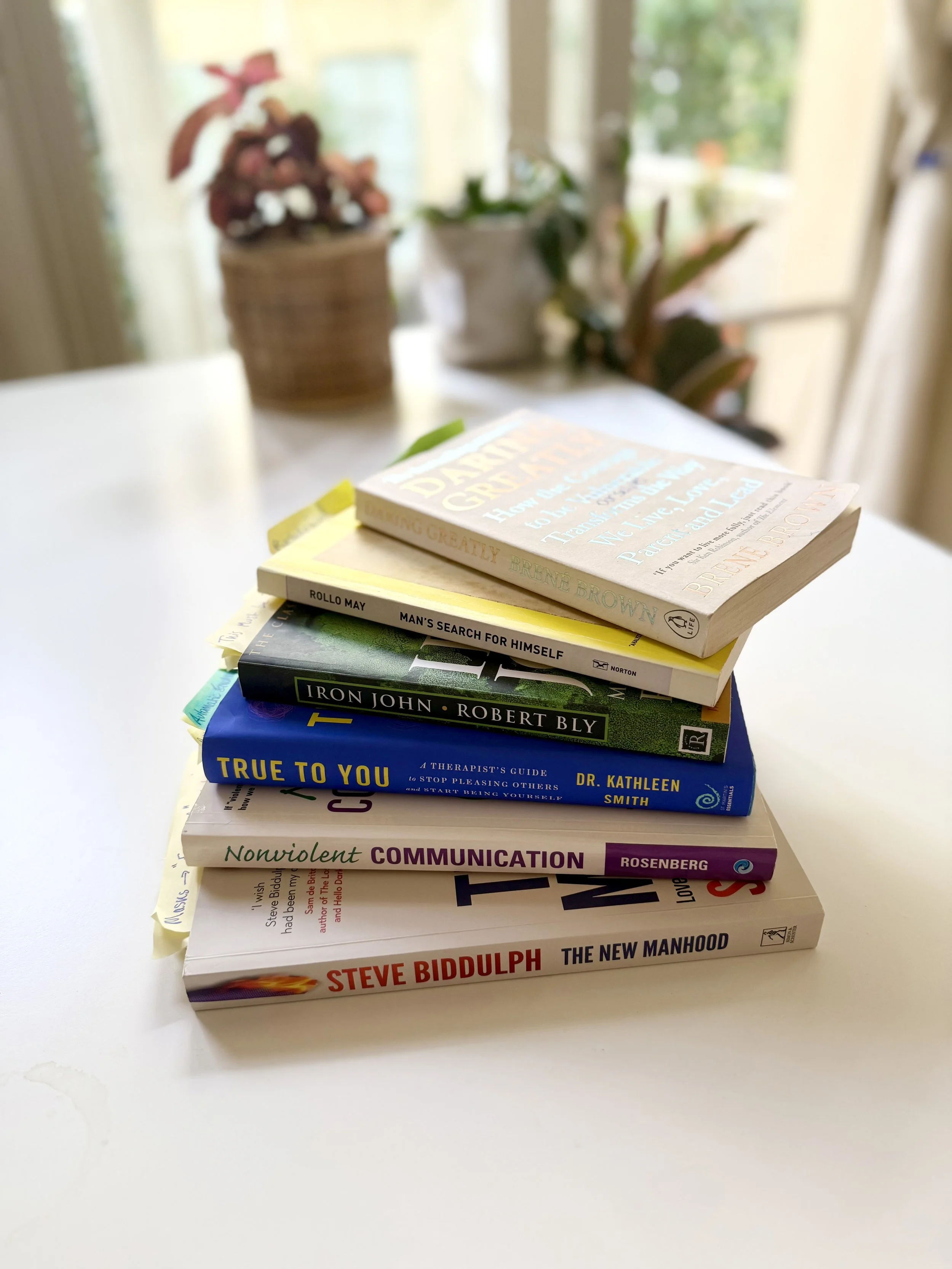
True To You: A Therapists Guide To Stop Pleasing Others and Start Being Yourself, is a useful read on spotting unhelpful patterns and being more yourself.
Nonviolent Communication: Life Changing Tools for Healthy Relationships, is a useful read on communicating your needs and getting your needs met. So many blokes find this book useful.
The New Manhood is a a timeless men’s classic. A “handbook for men” it offers up a no nonsense look at all aspects of being a man, including wearing a mask, fixing things with fathers, intimacy, masculinity, marriage and being a dad (what Biddulph calls a mask, Brene Brown calls armour).
Iron John: A Book About Men, provides a new vision of what a man can be based on a combination of psychology and mythology.
Man’s Search for Himself is an insight into a man’s existential questions he wrestles with.
Daring Greatly is one of Brene Browns best and offers men a strategy to remove the armour.
At the same time as 2) rediscovering who they are, they 3) get their health and stress under control.
3. Put Their Health First (and Reduce Stress)
In the first half of life, many men become so focused on climbing the ladder and being the provider that they rarely stop to consider the personal cost. Over time, the obligations, pressures, constraints and responsibilities that come with this role can gradually take a toll through chronic stress. To cope, many men turn to alcohol, fast food, cigarettes, vaping, porn, gambling or drugs as a way to “blow off steam” “decompress” or “unwind.”
In the short term, these habits offer relief, but it is temporary. In the long-term, they begin to erode physical health and mental wellbeing. Often without fully realising it, men start to put their health second to their responsibilities meaning self-care and mental wellbeing quietly become de-prioritised. Because the consequences are often invisible and masked by the very coping mechanisms used to manage stress, many men convince themselves that “she’ll be right, mate”, feeling as though they’re indestructible and can keep pushing through without paying a price. Meanwhile, the health costs of chronic stress and unhealthy coping mechanisms continue to accumulate beneath the surface, until one day they can no longer be ignored.
Then, at 40+, reality hits. The urgent life event—a life-threatening illness, heart attack, sudden health breakdown, “health scare”, or a major operation—hits them hard, forcing them to confront what they have been denying for years. In the aftermath, men can find themselves saying things like: “My time is running out” “I’ve lived more of my life than I’ve got left to live” or “If I don’t look after myself, I won’t live much longer.” For the first time, they realise the damage has been building for decades and recognise the true cost of putting their health last. What Wayne Phipps describes in his video I Quit at 53 is a familiar story for many men. Wayne says, “I started drinking more—having a bottle of wine with every dinner. And not eating the best—eating McDonalds.” But it was the letter from his GP that said, “You’re now prediabetic” that made the reality of his health situation hit home. Wayne realised, “I know that I hadn’t been treating myself right. That I’m treating myself badly.” His lesson learned was simple: “health isn’t optional. It’s foundational to have any kind of future to look forward to.”
For men in the same boat as Wayne was, it is a “wake-up call.” They are confronted with the fact that if they don’t look after their health, they may not be around to enjoy the future they have worked so hard to build. As a result, they are forced to do a u-turn—put their health first, rebuild their health, reduce stress, and reverse the issues they’ve experienced. This gives them the best chance of turning their health around, extending their quality of life, and creating a future they can actually enjoy.
Put their health first
Here’s what I’ve noticed about how blokes put their health first and rebuilt their health:
When I look at blokes who successfully put their health first and rebuild their health, a few big shifts stand out: First, they get realistic. They stop chasing performance and start focusing on presence. They pick exercise that suits their age and focus on exercise for functionality rather than cosmetics. Second, they start small. Instead of overhauling everything, they rebuild their health in small incremental adjustments, slice change thin, scale things down and shrink goals to make them achievable. They also build structure. A simple daily routine that keeps them healthy. And finally, they rebuild by experimentation and trial and error. They follow a process I call “Add-Assess-Adjust.” They add something new—a new gym routine or a social tennis session—they assess how their body responds and adjust by dialling it up or down.
Now we’ve covered the bigger picture, we can get into the day-to-day.
Here are real life client stories for how they do it:
Playing social tennis every week
Getting their bloods done every year
Getting a regular GP
Cutting down on food portion size
Buying from the local farmers market
Starting to play water polo again
Getting out for bush walks at the weekends
Dropping the booze out
Doing 10,000 steps per day
Walking the dog every morning
Getting back to the gym every morning/evening
Reduce stress
Here’s what I’ve noticed about how blokes reduce stress:
The standouts are that they establish and enforce boundaries to dial back work hours, and they find their voice and learn to say “no” politely when necessary.
Here are real life client stories for how they do it:
Not connecting phone to work email
Not receiving or making calls after hours
Saying to their boss that they’re not available after 5pm (“that’s the time with my family”)
Working 2 days a week out of the office from a separate work space
Speaking up to management about offloading workload to other staff
Here’s a video from Peter Fritz (YouTube channel: Act Two) talking about addiction to stress, being productive and having a heart attack at 39. He also offers up tools and tips to reduce stress, like saying no and reducing obligation load.
Books on Health and Stress
For a deep dive into health, stress and building habits, here are a few books you might find useful:
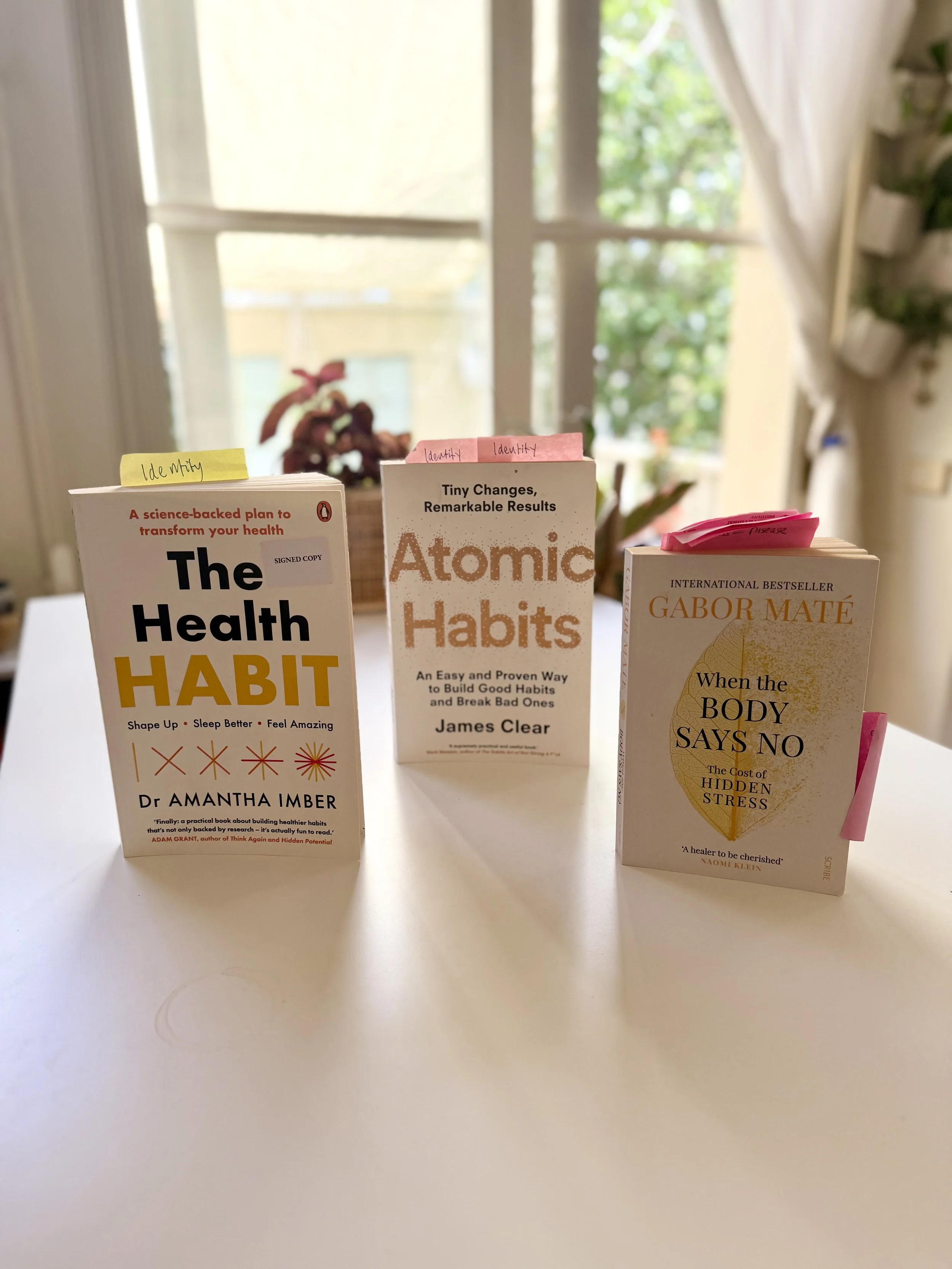
Atomic Habits is the classic book for building good habits and breaking bad ones. It’s a simple read and easy to digest. Loads of blokes, from construction foreman to execs find this book useful.
The Health Habit is the health version of Atomic Habits. It focuses on sleep, movement and nutrition, then offers the “how to” to make the new health habits stick.
When The Body Says No: The Cost of Hidden Stress, was a groundbreaking book to understand stress and it’s impacts on me. Mind blown! Here is a 1 hour talk by the author if you want to watch that instead of read the book.
They are now well on their way to 2) rediscovering who they are and 3) rebuilding their health and ability to manage stress. Laying these building blocks gives them a solid foundation to set out and 4) find a new meaning and purpose
4. New Meaning and Purpose
Meaning and purpose 101
“One who possesses a sense of meaning, experiences life as having some purpose or function to be fulfilled.” —Existential Psychotherapy
Meaning
Meaning is the feeling that our lives matter—that our lives mean something. That who we are, what we do, the way we live, and how we use our limited time on earth have significance, importance, value, and impact. For many blokes, the feeling that their lives matter comes from making a mark and leaving a legacy.
Men first want to make a mark—to know that others will recognise they were here, that they existed, that they were real; a permanent reminder that they once lived and breathed. Something that says, in a clear and unmistakable way, “I was here.” Ultimately, it’s the wish to leave a distinct and enduring imprint—a stamp, fingerprint, craft, body of work, contribution, or impact on the world that feels uniquely their own. This sense of marking one’s existence often becomes the starting point for something even larger: legacy.
Legacy is what remains after that mark has been made. Leaving a legacy looks beyond how they are seen now, toward the desire to be remembered after death—to succeed beyond their passing, and to “live on” after they’re gone. This often shows up through a drive to create something that outlasts them, whether that’s intentional “legacy projects” or simply the by-product of a life’s work that has a long-lasting impact and continues to matter beyond their lifetime. That might include living on through their kids, making charitable contributions, building projects or creative work that endure, or passing on their estate, possessions, knowledge, skills, or craft to the next generation. For some, it extends to having their name attached to buildings, monuments, books, or institutions. For others, it’s about being recorded in history in some way—through their ideas, achievements, or life’s work—so that their contributions continue to ripple forward. At its core, legacy is about symbolic immortality—something of them remaining in the world after they are gone, influencing future generations and the ongoing story of human life and progress.
Put simply: Making a mark is proof of existence; leaving a legacy is the lasting impact of that mark. The mark is the act; the legacy is the residue. Men want their lives to count now by making a mark and to continue to matter through the legacy they leave behind. For many men, their sense of meaning in life increases when they believe they have made a significant mark and left something enduring behind.
Purpose
Once they have a clearer sense of what gives their life meaning, their purpose—their point, role, reason or function—naturally comes into sharper focus. Purpose is not a goal. Instead, it’s an attitude they take towards living out their meaning. In other words, purpose is the lived expression of meaning. Here’s my example: I work part-time as a counsellor with kids. Being a counsellor gives me the belief that I will positively influence the kids’ lives and impact their future generations. In this way, I hope to live on through the kids (meaning). The meaning then gives me purpose—a reason to show up and work hard at being a good counsellor, so that I can fulfil that meaning. In this way, purpose is not separate from meaning—it is the lived expression of it in day-to-day action.
Famous examples of how people 40+ construct meaning
Around Melbourne you will find the Ian Potter Centre Art Gallery at the NGV in Federation Square, the Potter Museum of Art in Parkville and the Ian Potter Music Centre in Southbank. But who was Ian Potter? Ian Potter was a stockbroker. But who is going to remember a stockbroker?! So in 1964, at the age of 62, he established the Ian Potter Foundation and began giving away much of his wealth to support arts, education, and community organisations. He died in 1994, but his name continues to live on—attached to these buildings across the city. Remembered not as a stockbroker, but revered as a philanthropist and supporter of the community, whose impact still shapes the cultural landscape. And he’s not alone. The Tate Modern art gallery in London is named after ‘sugar’ magnate Henry Tate who donated the funds to start the gallery. The list goes on.
The moral of the story is this: After 40 we re-construct the mark we want to make and self-determine the legacy we leave behind.
Finding a new meaning and purpose
In the first half of life, society gives men a ready-made source of meaning: that success—wealth, fame, professional status, title, and achievements—is the surest path to a meaningful life. In societies eyes, the more successful they become, the more valuable, important, and significant they are thought to be. Career progression is often seen as the socially prescribed and most direct path to success. Career progression is therefore presented as a vehicle for meaning—not merely as a way to earn a living, but as a way to matter.
As a result, many men spend the first half of life pursuing meaning through their career. Climbing the ladder, building expertise, earning recognition, accumulating wealth, and in turn providing for their family become tangible ways of making a mark and building a legacy. Their purpose is clear: to strive, achieve, provide, and succeed in service of that meaning. They have direction, structure, and a point to life—they have a function to be fulfilled and a reason to get out of bed in the morning.
But the urgent life event—a redundancy, divorce, life-threatening illness, “health scare,” heart attack, or the loss of a parent, family member or colleague—can destroy that framework. For some men, these events force them to confront their own mortality, find themselves unable to function normally and see the life they have built compromised. In the aftermath, men can find themselves saying things like: “I don’t know what’s real anymore” “Whats the point?” “I have lots of questions about what’s really important” “Is this all there is?” “Does anything I do ‘actually’ matter?”
Suddenly, the things society taught them to value no longer provide the same sense of meaning and purpose. The old sources of fulfilment begin to lose their power. It all seems pointless. Climbing another rung on the ladder no longer seems important. Making more money loses its appeal. Success itself can start to feel empty. What mattered in their 30’s—the title, status, corner office, boozy lunches and prime parking spot—now feels hollow. They find themselves a changed man—no longer the person who once wanted all those things.
Now, a new search for meaning and purpose begins—one that reflects who they have become today, not who they used to be. Where external success once took priority, they now find themselves drawn to a deeper need for inner fulfilment. They want to do something “close to their hearts” or something that “lights up their soul.” At its core, this is a desire to contribute to something greater than themselves, to be of service to others, and to make a difference in the world. Through this new pathway, they begin to make a significant mark and leave a legacy no longer defined by success, status, wealth, or achievement—but by contribution, service, and making the world a better place.
Achieving this requires a profound shift in focus—from themselves to others. In the first half of life, the focus is largely on the self: What can I get? What can I achieve? In the second half, the focus increasingly turns towards others: What can I give? How can I contribute? It is a shift from personal achievement to contribution and service. In other words, they find new meaning and purpose in using their knowledge, experience, and skills not to enhance their own lives, but to positively impact the lives of others and make the world a better place.
I notice men find a new meaning and purpose in any one—or a combination—of ‘7’ ways:
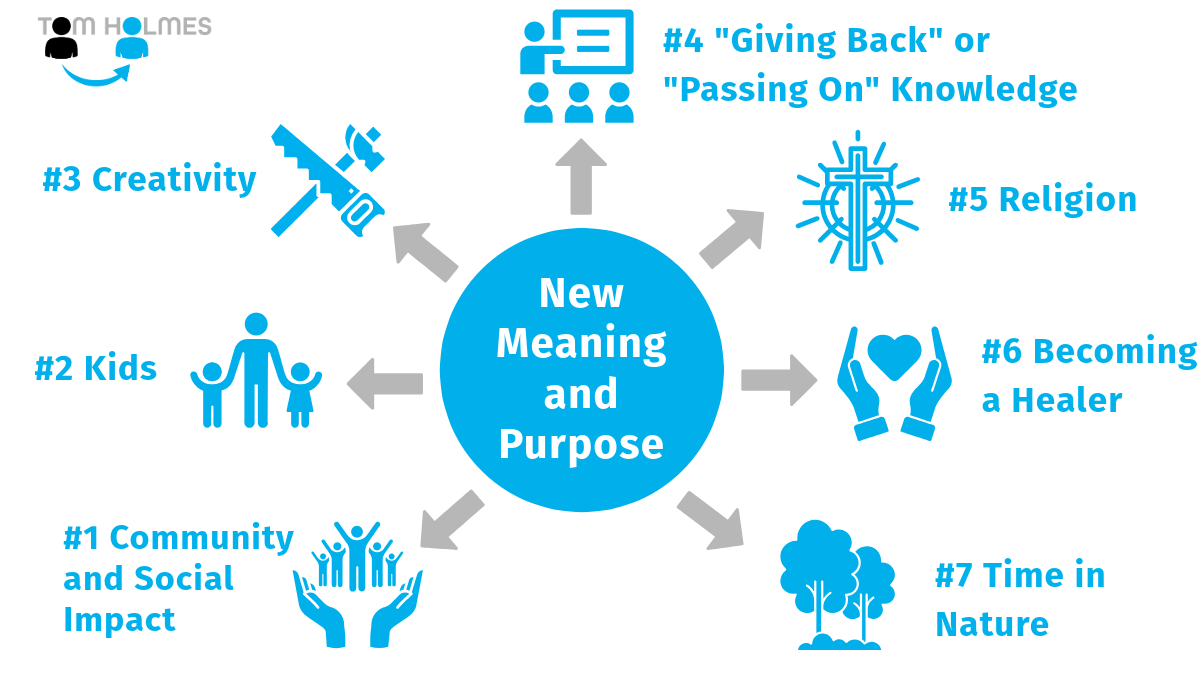
#1 - Community and social impact
Men find new meaning in making a mark and leaving a legacy by having a positive social impact on others, their community and future generations. Men who pursue this path gravitate towards non-profits, healthcare, education or social enterprises. They find ways to “give back” to their local community; champion a cause they believe in; drive social change; advocate for justice and fairness; get involved in fundraising; support mental health; help those in need; work to right a wrong; fight to preserve, protect, save or stop something historical, traditional, significant, important or unique from being lost; stand up for people, values, or principles they care about; create opportunities for others that they themselves never had; pursue charitable interests; and contribute to causes that improve the lives of others. They pursue this path through both work-related and non-work-related roles.
In work-related roles, some men recycle their old skills from their “big” careers in the first half of their lives and repurpose their “transferable skills” in organisations dedicated to improving the lives of others. In doing so, they use their old career, professional expertise, established networks, and proven experience as a bridge to more meaningful and purpose-driven opportunities. Many transition from corporate leadership roles into the non-profit sector, applying their professional experience and expertise to causes they genuinely care about. Some blokes who run a business donate a percentage of their business profits to charitable causes or volunteer as a pro-bono consultant donating their director or executive expertise to non-profit organisations. In this way, they use their business and expertise as a vehicle to support meaningful organisations and causes.
Other men take a non-work-related approach to making an impact. Some choose to donate their time to others through volunteering at a soup kitchen, working in an op shop, or supporting their local church. Others focus on civic or community advocacy—writing letters to the newspaper, organising or signing petitions to protect causes they care about, or engaging with their local electorate through council or political party involvement.
Through both work-related and non-work-related contributions, men can see the tangible impact of their efforts on others and their communities. This creates a renewed sense of purpose—feeling useful, valued, and part of something larger than themselves. In making a difference, they experience their work not just as activity, but as meaningful service where their contribution genuinely matters.
Here are real life client stories for what men went from and to:
Flight attendant to working in a community library
Medical sales to volunteering at the CFA
Banking fraud to managing a butcher shop
Change management consultant to working at a fruit & veg market
Executive general manager of accounting in construction to CFO for a not-for-profit
Distribution manager to working at a local surf shop
Corporate finance to aged care
My own journey: Construction project management to counselling in a primary school
You may be questioning, how do people actually make this financially viable and make a living from it? But they do, with the tools and strategies in the time section. While that covers finances, my Phase 5 - Reinvention page lays out the more practical sequence of tasks required to make these career transitions.
#2 - Kids
Men find new meaning in leaving a legacy through their kids—including their grandkids—by creating a positive impact on the flow of future generations. They do this by being an active and present father; showing interest in what their kids are into; spending less time at work and more time with their kids; simply being there for them; making time to connect and repair relationships; prioritising connection over being buried in spreadsheets; cultivating rituals together; giving their kids experiences; becoming a “professional memory maker” and making memories together; and being a more consistent male figure in their lives.
This is where the economic remodelling really pays off. The time they now have to spend with their kids is priceless. The moments they can now gift their kids and the memories they make together will stay with them long after they’re gone and will transcend their lifetime. Like a ripple effect, the positive impact they have on their kids will flow through them and radiate out onto future generations, giving their life importance, value and significance. This gives them a new purpose: they have a clear role; are motivated to be a positive male role model; to instil good morals and values; demonstrate positive habits; they feel useful and needed; and it makes them want to be a better man and show up as the best version of themselves.
Here are real life client stories for how you do it:
Doing the pick ups and drop offs from school, making lunchboxes and doing the kids sport
Turning the phone and laptop off when home and not taking after hours calls
Picking his son up after school every day and riding their push-bikes home
Walking his daughter to the bus stop every morning
Building a camper van and taking his kids on trips around Australia on school holidays
Getting early access to his super so he could give his kids a skiing experience “before he’s ‘too old’ to be able too”
Camping or travelling together
Going on his son’s school camp
Games night
Banning technology for a night of the week. No screens, laptops, TV or phones. One bloke called it “NTT”—No Technology Tuesday.
Cooking and baking together
#3 - Creativity
Men find new meaning in making a mark and leaving a legacy by creating something uniquely theirs that has a positive impact on the lives of others and will continue to exist after they’re gone. In The Seasons of a Man’s Life, a fantastic book about a man’s life cycle, author Daniel Levinson describes the creative process for a man in midlife. Daniel says, “the creative impulse is not merely to ‘make’ something. It is to bring something into being, to give birth, to generate life. A song, a painting, even a spoon or toy, if made in a spirit of creation, takes on an independent existence. In the mind of its creator, it has a being of its own and will enrich the lives of others who are engaged with it.”
I’ve noticed that there are two main factors that trigger the creative impulse in men over 40: first, having kids, and second, awareness of their own mortality. I’d go as far to say that the first triggers the second. If you watch enough creative TV shows like Grand Designs or Restoration Man you’ll begin to spot both these patterns.
Having kids
Daniel is spot on: it is not only women who give birth. In Grand Designs and home renovation shows alike, you’ll often notice the same familiar pattern: a middle-aged couple building or renovating their “dream” forever family home. But you’ll often see a striking imbalance in roles. Typically, the wife has recently given birth, is pregnant with another child or they have young kids. She stands by in a supportive role—managing the existing household, caring for the children, and keeping an eye on the budget from afar. Meanwhile, the husband throws himself into the project on-site with relentless intensity. The building project becomes unmistakably his mission: driven, obsessive, unwilling to accept limitations around budget or timelines, and determined to prove the vision can be realised no matter the obstacles.
Why does this dynamic appear so often after the birth of a child? I believe it’s because seeing his wife give birth triggers a parallel instinct in him—a desire to give birth to “his” own creation. He doesn’t go into labour himself but he has his own labour. He’ll say, “It’s been a ‘labour’ of love.” In Series 16, Episode 2 of Grand Designs UK, you can see this dynamic clearly play out. In fact, at the end of this episode (at 43:06 mins) the wife actually says, referring to her husband, “When he was really sapped of energy, it probably does feel like Harry’s given birth to this house. It has been that long and painful.” The presenter even refer’s to the two main on-site carpenters as his “midwives.”
I’ve seen men follow this instinct by building their own houses or starting and growing businesses with similar intensity, triggered either by preparing to have kids or by already having young kids. But it’s not just about creating a home or a business itself. The home or business has a much deeper and more significant new purpose: it becomes an expression of a man’s evolutionary drive to create something that provides, protects, and builds security for his new family.
Awareness of their own mortality
“In midlife, a man reviews his life and considers how to give it greater meaning. His growing recognition of his own mortality makes him more aware of destruction as a universal process. Knowing that his death is not far off, he is eager to affirm life for himself and the generations to come. He wants to be more creative. Thus, both sides of the destruction/creation polarity are intensified in midlife. The acute sense of his destruction intensifies his wish for creation” explains Daniel in The Seasons of a Man’s Life. In other words, the awareness of a man’s own mortality triggers a strong creative impulse to make something—to make a mark and leave a legacy.
This desire is often expressed through tangible creative works that leave a lasting “stamp” on the world—a statement that signals they existed. In other words, the creations declare, “I was here.” They also form part of the legacy: these works outlive their creators, continuing to exist long after they are gone. They carry a distinct identity that can be traced back to them, marking the work as uniquely their own. In this way, they are forever “known” and remembered for something specific and enduring—the contribution they made. A clear example of this can be seen in this episode of Restoration Man. At the end of restoring his “happy ever after home”—an 18th-century school house—middle-aged renovator Jim reflects: “I’m restoring this lovely old building. It will be standing here when I’m long gone and hopefully one day in the future someone will say, ‘I know who repaired that—it was Jim.’”
This gives them a new purpose: they feel like the point to their lives is to live their legacy into existence.
Here’s what I’ve noticed about how blokes start something creative:
They revisit the things that lit them up when they were children—what they grew up doing with their parents, a family tradition, or something they started but never finished. They engage with these things again, see if they resonate today as they did back then, and give themselves permission to restart and pursue them. Inspired by role models, they observe the creative pursuits of parents, colleagues, or family members and try them out for themselves. They might take a training course or workshop in something “they’ve always been interested in,” stumble upon something by chance, love it, and follow their interest from there. They create a project for themselves, like building or renovating a house or restoring a car—something with a goal, timeline, and budget. Often, these projects carry a deeper meaning, connecting them to their lineage and ancestry, and occasionally, they dedicate them to a loved one who has passed: “Dad would be proud.”
Here are real life client stories for how you do it:
Starting a landscaping, gardening or property development business
Building their own house
Picking up the guitar
Doing up and selling cars
Playing drums in an African band
Making wooden pepper grinders on a lathe
Making or restoring furniture
Woodworking
Grabbing cook books from the library and trying out new cooking and baking recipes
Many blokes have longed for what creativity provides. In fact, men will say, “creativity is like medicine.”
#4 - “Giving back” or “passing on” knowledge
Men find new meaning in making a mark and leaving a legacy by “giving back,” “passing on” or sharing their knowledge to positively impact the lives of others and future generations. In other words, they teach others what they know. Men who follow this path gravitate towards mentoring, coaching, advising, teaching, storytelling speaking, podcasting, writing, blogging, training, consulting, counselling, lecturing, facilitating groups or giving talks.
In my experience, meaning created in this way generally involves this four phase process: 1) packaging up their life story, urgent life event story, story of overcoming adversity, special talent, unique interest, invaluable information, knowledge, technical expertise or proven experience; 2) filtering it through relevant—often recently completed—qualifications, certifications or training’s; 3) translating that into lessons learned, concepts, powerful messages, theories, advice, techniques, formulas, “how-to” instructions, strategies, models, practical steps, skills, habits, problem solving solutions, tools or teachable material, and; 4) sharing that with the world by “giving it back” or “passing it on” to others through various formats—such as one-on-one, classroom teaching, live audiences, YouTube, online content, social media, blogs, articles, books, info products, webinars, podcasts, online membership platforms, or training programs.
In the first half of their life, it’s likely they had mentors or positive male role models who facilitated their advancement, taught valuable skills, provided guidance, shared lessons learned, and acted as people to look up to; sports coaches who instilled in them rules, skills, and morals; teachers who believed in them; training that added valuable new skills to their bow; or lectures and talks that powerfully changed their outlook on life. Off the back of what these people and experiences meant to them, they take their know-how, reverse the role and become a mentor, coach, teacher, trainer, advisor, lecturer or give talks to others. This gives them a new purpose: they feel they are making productive use of their story, knowledge, skills, and experience; carrying a torch or flame that keeps lineage, movements, traditional methods, stories, or knowledge alive; and sharing their wisdom in a way that makes them feel useful, valued, needed, and of service. In doing so, they also gain the reward of inspiring and empowering others to improve their lives.
Here are real life client stories for how you do it:
Mentoring and up-skilling younger staff
Coaching kids soccer or footy
Giving talks on mental health to primary schools
Doing a travel radio segment
Writing articles and blogs on topics of interest
Writing a book
Managing the ball kids at the Australian Open
Rowing coach
Mentoring leading hands into foreman
My own mentoring: Mentoring young people aged 10-22.
#5 - Religion
Men find new meaning through religion. They may discover a new faith or dust off and reconnect with a previous religions upbringing. Religion gives them answers to existential questions, connects them to a divine plan and higher power and provides a framework for moral guidance and values that gives their life significance. They feel part of something larger than themselves and have a clear path for living, often centred around worship, and preparation for an afterlife. This gives them a new purpose: they gain a strong sense of community and social support; engage in rituals, prayer and service that guide their daily life; are of service to others; and in service to God.
#6 - Becoming a healer
Men find new meaning in making a mark and leaving a legacy by becoming a healer, and healing, teaching or instructing others in that healing modality. Men who pursue this path are often drawn to non-conventional, alternative holistic healing modalities, involving hands-on, touch-based therapies, mind-body techniques, energy work, techniques aimed at shifting psychological states, holistic practices, or natural remedies such as acupuncture, remedial massage, yoga, meditation, naturopathy, breathwork, reiki, hypnotherapy or Chinese medicine.
They typically discover these alternate healing modalities through their own experience. The urgent life event may be the diagnosis of a physical health condition, disease or cancer, or a serious accident or operation that prevents their normal functioning or a flare up to a pre-existing injury or health condition that’s been present from birth. Their healing and recovery often starts by following conventional, mainstream, “Western” medicine. But this often leads to a dead end and they wind up thinking this “isn’t working” or “doesn’t feel right.” Having exhausted the “Western” treatment options they often feel desperate like they’ve got nothing to lose in trying alternate healing modalities. The alternate modalities often provide a powerful, and successful healing experience that irreversibly shifts their perspective on body, health, beliefs and worldview.
They are so moved by their healing breakthrough that they are called to heal and teach others and they enrol in a course, certification or training to become a healer in that modality. In other words, they become a healer off the back of their own healing journey. They may become a one-on-one healer or an instructor or teacher passing on the philosophy, techniques and spiritual guidance associated with the modality. This gives them a new purpose: their function in life is to heal others and share their new found knowledge.
Here are real life stories for how you do it:
Corporate finance to remedial massage therapist & myotherapist
Boiler maker to spinal flow technique therapist
Builder to hypnotherapist
Fireman to yoga teacher
#7 - Time in nature
On the surface, it might not seem that spending time in nature provides meaning and purpose, but in fact, it does. Spending time in nature (including adventure, exploration, and travel) provides new meaning by helping them see themselves as “part of nature” and offering them a “bigger picture” perspective: that they are part of evolution, part of the fabric of life, and part of a larger whole. It can help them realise that, simply by existing, they participate in and shape the world around them, leaving a tangible mark on the world. It can strengthen their sense of identity by reconnecting them with land, country, ancestry, or culture; expand their understanding of humanity (and themselves) through exposure to diverse cultures and countries; teach them their place within the natural cycles of life, death, and the seasons; and help them reconnect with and attune to their own internal rhythms through connection with the rhythms of nature.
The result, is that time spent in nature acts like a pressure release valve, bringing balance, centredness and a restorative effect. This gives them a new purpose: to fully, deliberately, and intentionally engage with life, and a sense of responsibility to look after, care for, and protect nature, wildlife, and the planet.
Here’s how you do it:
Notice the small, simple, day-to-day beautiful things and moments all around you. Wonder, be curious and marvel at the world. See the world like a kid again. Appreciate the gift of life itself. Have a basic appreciation for what you already have. Foster gratitude for just being alive—that you’re lucky to just exist. Live in the present moment. Gain satisfaction from the process of just living—from just being, rather than doing or having.
Here’s the tool kit for how you do it:
Day-to-day: Start the day in nature—walk the dog, watch the sun rise and listen to the birds sing; just be in nature without goals, an agenda or distractions; watch the leaves fall from the trees in autumn, smell the flowers on the street, smell freshly mowed grass; or lie on the grass and look up at the sky.
Trips in nature: Go for a bush walk; go fishing, camping, 4WD’ing or mountain climbing; or go for a swim in the ocean, a lake or river.
Growing: Grow herbs, plants or crops; raise animals; or gardening.
Travel: Head away on a trek; book a safari; or walk a famous trail, wall or pilgrimage. I notice many people in midlife walk the Camino de Santiago, in Spain.
Work: Wildlife conservation; reef restoration; or planting trees.
Ticking many boxes
Men tend to think of these as 7 “tick boxes.” They often tick a number of these boxes. In other words, it’s rarely just one thing that provides new meaning and purpose; more often, it’s the combination of many things that provides new meaning and purpose for men over 40. In his blog about Midlife Career Change, Modern Elder Academy (MEA) Founder, Chip Conley lays out what this can practically look like. Chip says, “Instead of one full-time job or working exclusively for one organisation, they work part-time in various capacities. Not one demanding job but several smaller commitments that add up to something that actually fits their life. The variety keeps their brain sharper than any single job ever could.”
Chips onto something here. Men often assume that finding new meaning and purpose means they have to quit their jobs, abruptly leave their career, abandon the life they already have and leap into the unknown towards a more purposeful life. But in reality, the new purpose could be much closer than that—right on their door step, in fact. Instead of quitting their job or making drastic career changes, men can use, build on or adapt the skills they already have and “bolt-on” new sources of meaning and purpose to their current life. For example, a man’s week might involve serving as a company director from Monday to Wednesday, volunteering at a soup kitchen on Thursday, and building furniture in the shed on Friday. Each weekday morning, he walks his daughter to the bus stop, and on Sundays he attends church while helping run the service’s audio-visual production. Viewed individually, these activities may seem small or unrelated, but together they create a range of “bolt-on” sources of meaning and purpose that enrich and expand the life a man already has. These “bolt-on’s” are usually discovered through exploration and experimentation, then gradually integrated into everyday life.
Exploration and experimentation
Successfully finding new meaning and purpose requires exploration and experimentation. Men can’t “think” their way into a new sense of meaning and purpose—they have to discover it through action. Rather than endlessly analysing their options, they need to run small, low-risk “pilot studies” across the 7 tick boxes, “trying things on for size” and “test-driving” different possibilities to see what they enjoy and what resonates with them. Much like taking a car for a test drive before deciding to buy it. Firsthand experience provides the clarity that analysing alone cannot. In his blog about Midlife Career Change, Modern Elder Academy (MEA) Founder, Chip Conley describes this process as “reconnaissance missions, not commitments. Gathering intelligence, not storming the beach.”
In his book Useful Not True, Derek Sivers’s has a similar philosophy to Chip. Derek says, “test first: before deciding, try it.” The theme is clear: test things out before committing. By testing things out, they can dip their toe in the water and test out a different kind of life without putting their future at risk and validate their interest and fit before making a major commitment. While it would be ideal to approach this as a clear, well-defined project, the reality is usually slower, messier, and filled with U-turns and dead ends. It requires patience. It takes time, but new meaning and purpose will materialise if they keep looking in different directions, experimenting with possibilities that appear interesting and follow the things they enjoy.
Here are the ways you can start experimenting:
Joining a workshop, training course, short course or evening class
Enrolling in a course of study like a certificate or diploma
Going to talks or events in the area of interest
Heading down to a men’s shed
Testing your expertise by offering a free talk
Interviewing people already in a field you’d like to explore
Shadowing someone already doing what you’d like to do (job shadowing)
Getting a temp job or contract work in the area of interest
Offering your services as an independent consultant
Try making something creative on a small scale
Writing out your story and getting feedback
Volunteering or doing pro-bono work to test new sectors
Experimenting can be done without leaving your current job. Many blokes do it in parallel or overlap the experimenting with their current job by doing it in the evenings, at weekends or by taking annual leave days.
Meaning vs money
Some men make a living from their new meaning and purpose—they do meaningful work and earn enough money doing it to cover their living costs. They may retrain, and become a teacher, which offers them a new meaning and purpose at the same time as providing their income. In other words, meaning and purpose, and finances and money are combined.
Other blokes separate the two. Other men have a job—often not what they’re interested in—or a source of passive income on one hand, which provides the finances that supports and sustains their new meaning and purpose on the other hand. In other words, the money fuels the meaning. In this scenario, men have said to me that they can allow a new meaning and purpose to organically grow that is free from pressure to bring in money. They may have a corporate job and in the evenings and weekends are a kids soccer coach.
Books on Meaning & Purpose
For a deep dive into meaning and purpose (which dip into identity too), here are a few books you might find useful:
Finding Meaning in The Second Half of Life, does what it says on the tin. It offers ways men can grow, evolve and fully become themselves in the second half of life.
Passages in Men’s Lives examines the issues facing men at midlife and lays out a map for how men can reinvent themselves in the second half of life.
The Seasons of a Man’s Life, lays out the study of 40 men and from that builds a model of a mans life cycle.
Second Act Careers offers 50 ways men can profit from their passions in their “second act.”
Transitions, is a timeless classic providing a road map to navigate change.
The Middle Passage: From Misery to Meaning at Midlife, is a concise guide for men to redefine themselves and re-orientate in midlife.
The War of Art is a straight shooter, no-nonsense look at the creative process.

The Feedback Loop: The Impact of a New Meaning & Purpose on Identity
The new meaning and purpose acts like a vehicle to better understand themselves, rediscover who they are and reinvent who they want to be in the future. Whether it be writing, painting, starting a business, working for a not-for-profit, picking their kids up every day after school, teaching or growing plants, the new meaning and purpose: Is an expression of their voice; is a form of communication; locates where they are in the world; tells them how they’re functioning; is a reflection and expression of who they are—what they value, believe in, care about and stand up for; and is a tool to learn about themselves every time they do, make, write or create something.
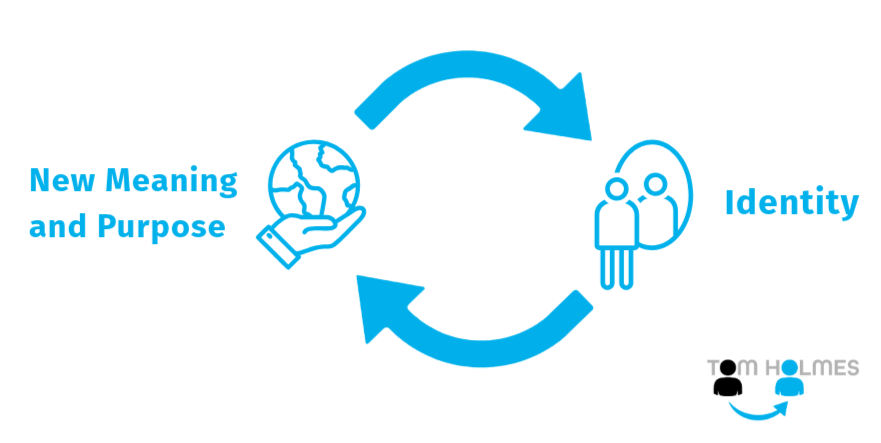
By concretely expressing themselves into the world, they get clearer on who they are (and just as important, who they are not). Many creatives describe the act of creativity as therapeutic. But in reverse, the clearer they are in who they are, the more confident they can be they are pursuing the “right” meaning and purpose. It’s like a feedback loop: meaning and purpose influences identity; and identity influences meaning and purpose.
5. Learn New Skills, Grow and Reach Their Potential
In the first half of life, men typically learn new skills to be better at their job. Often, they grow professionally but not personally—they stop growing as a person.
Now at 40+, a by-product of 1) controlling their time, 2) rediscovering who they are, 3) putting their health first and 4) finding a new meaning and purpose is 5) learning new skills, in what “they’re interested in.” Learning new skills isn’t something they necessarily set out wanting. It just happens naturally and organically as part of the process. But it plays a crucial role. Along the way, they build new habits, hone skills and develop tools. As a result, they can see themselves improve, develop, expand and get better. This translates into concrete signs of progress, forward movement and ‘personal’ growth. They can see the positive work happening, which builds a sense of confidence and capability, and motivates them to keep going. This fulfils a fundamental human biological need to keep learning, evolving, grow as a person, and reach their potential.
The Urgent Life Event as Both Crisis and Opportunity
So that wraps up the 5 things. Now we’ve come to the end of the 5 things, we can look back at the urgent life event from a different vantage point and see that it was both a crisis and an ‘opportunity.’ It catalysed them into a new journey of growth. Without the urgent life event, they’d most likely never have been motivated to take a new path. At this point, men will often say they’re grateful the urgent life event happened to them. ”It was the wake up call I needed” they’ll often say.
In New Manhood, a fantastic book providing a handbook for men, author Steve Biddulph’s view is that men actually need crisis in order to grow. Steve says, “Nothing sets us up for problems quite as much as the idea that life is an upward journey. We are taught to expect constant improvement, so it’s easy to feel terrible failure, when setbacks occur, in career, health, family or finances. The older traditions take a different view. They teach that, in an authentic man’s life, we need to be defeated by greater and greater forces, because we are trying to do greater and greater things. Psychologists working with men have noticed that having things go badly, while hardly something to say Whoppie! about, often means that you are about to break through to a new level. There is something in a mans psyche that means suffering is the greatest teacher, that only through crisis do we really grow.”
I think Steve’s right!
Leading a Fulfilling Life
If you look at blokes who lead fulfilling and rewarding lives after 40, you’ll notice a common pattern. They do a combination of the 5 things. Now I’ve laid them out, do people come to mind who do these things?
You’ll notice they build their life structure around: 1) Time: Earning enough to live simply, modestly and freely. 2) Identity: They’re comfortable with who they are and have friends that support and uplift them. 3) Health: They have a daily routine, structure, habits and practices that keep them healthy. 4) Meaning and purpose: They engage in a variety of the meaning and purposeful pursuits that make them feel alive. They volunteer or help out in a community club, coach kids footy or work for an organisation that improves human lives. They create rituals, experiences and memories with their kids and do the day-to-day important stuff like making lunchboxes or doing the pick-up’s and drop-off’s. They engage in creative pursuits, build things or make products that enrich the lives of others. They teach, lecture, give talks, speak, mentor or guide others in some way. They have fostered a spiritual outlook. They live surrounded by nature or spend time in nature and explore and travel. 5) Growth: All of this means they continuously learn new skills, grow and evolve, and day-by-day uncover and live out the unlived life within them.
This may be a generalised, idyllic, perfect world or “fairy tale” view. Not all items are required for everyone and the allocation across the items will move and change with life. But it makes sense, doesn’t it? It gives us something to aim for.
Bringing This Back to Your Life
To bring this to a close and tie this back to your life, here are some questions for you:
Have you unwittingly discounted aspects of these 5 things which you already have?
What can you identify or acknowledge you already have or are already doing and can you reshape your view of what they mean to you?
Have these things reminded you of how much positive work and growth is already happening in your life?
Which aspects are you missing from your life, what do you want more of and what deliberate action could you take today to begin to move towards those things?
A “Labour of Love”
This blog has been my own “labour of love.”
It’s took me 7 years of working with men to be able to identify the common patterns and themes in men’s lives, extract from that the 5 standout things men 40+ want in life and 6 months to pull that together, draft and write this blog.
I expected writing this blog to be a mechanical process of translating patterns to text. But the truth is, it’s changed me. Just through the act of writing this blog, I’ve got clearer on ‘why’ these 5 things are important—to me, to men, to humans, to the world—which has made me do them more. I’ve found myself spontaneously heading out for an evening swim in Port Phillip Bay, meandering through one of Melbourne’s many gardens, smiling when the morning sun hits my face, getting absorbed in writing and just feeling more grateful for a slower pace of living and for being alive.
It’s enriched my life.
I hope in some way it has enriched yours.